


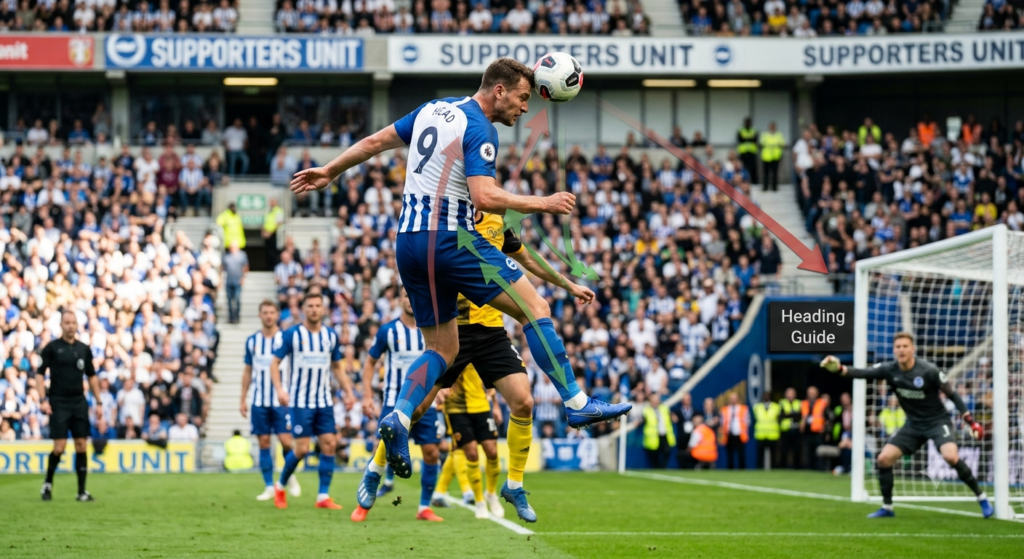
Heading is one of football’s most unique skills. Unlike passing, dribbling, or shooting with the feet, a header requires players to use their body, timing, balance, and courage to direct the ball accurately. Whether it’s scoring from a corner kick, clearing a dangerous cross, or making a clever pass to a teammate, mastering the header technique can make a player far more effective on the pitch.
While heading may appear simple, the best headers combine excellent positioning, precise timing, and strong body control. Professional footballers spend years developing this skill, allowing them to win aerial duels against opponents who may be taller or physically stronger.
In this guide, we’ll explain the correct heading technique, the different types of headers, common mistakes, and practical training exercises that can help players improve.
What Is a Header in Football?
A header is when a player intentionally strikes the ball using their head. According to the Laws of the Game, heading the ball is completely legal provided it is done safely and without dangerous play.
Headers are commonly used to:
- Score goals
- Clear defensive danger
- Pass to teammates
- Control long balls
- Win aerial battles
- Start counterattacks
Professional football matches often feature dozens of headers, especially during crosses, goal kicks, throw-ins, and corner kicks.
Why Is Good Heading Technique Important?
Players who master heading gain several advantages.
| Benefit | Explanation |
|---|---|
| Better finishing | Score more goals from crosses and corners |
| Stronger defending | Clear dangerous balls effectively |
| Improved passing | Redirect aerial balls accurately |
| Win aerial duels | Beat opponents in the air |
| Greater confidence | Become more comfortable under high balls |
A good header is about much more than simply making contact with the ball.
Understanding the Basic Header Technique
The movement can be broken into several simple stages.
1. Watch the Ball Early
The first step is tracking the flight of the ball.
Good players:
- Keep their eyes on the ball
- Judge its speed
- Predict where it will land
- Adjust their movement early
Late reactions often lead to poor contact.
2. Position Your Body
Before jumping, players should establish a balanced stance.
Key points include:
- Feet shoulder-width apart
- Knees slightly bent
- Chest up
- Arms out for balance (without pushing)
Proper positioning creates a stable platform before leaving the ground.
3. Time the Jump
Timing matters more than jumping high.
Experienced players rarely jump first.
Instead, they:
- Wait for the ideal moment
- Explode upward
- Meet the ball at its highest comfortable point
Jumping too early often allows opponents to win the ball.
4. Use the Forehead
The strongest and safest contact point is the center of the forehead.
Correct Contact Area
- Top of the head
- Side of the head
- Face
- Back of the head
The forehead provides maximum power and control.
5. Generate Power
Many beginners think power comes from the neck.
In reality, powerful headers involve the entire body.
The movement starts from:
- Legs
- Hips
- Core muscles
- Back
- Neck
The whole body moves forward through the ball.
6. Follow Through
After contact:
- Continue moving forward
- Land under control
- Prepare for the next action
Good balance allows players to react immediately after heading.
Different Types of Headers
Football uses several heading techniques depending on the situation.
| Header Type | Main Purpose |
|---|---|
| Attacking header | Score goals |
| Defensive header | Clear danger |
| Flick-on header | Redirect the ball |
| Downward header | Make scoring harder for goalkeepers |
| Diving header | Reach low crosses |
| Glancing header | Change the ball’s direction |
Each serves a different tactical purpose.
Attacking Headers
Attackers use headers to finish crosses from:
- Wingers
- Full-backs
- Corner kicks
- Free kicks
The goal is accuracy first, then power.
Most coaches recommend directing headers downward because bouncing balls are harder for goalkeepers to save.
Defensive Headers
Defenders often perform more headers than attackers.
Their priorities are:
- Distance
- Height
- Safety
Instead of trying to keep possession in dangerous areas, defenders usually head the ball away from goal.
Flick-On Headers
A flick-on slightly changes the ball’s direction.
This technique is useful when:
- Receiving long goal kicks
- Playing quick attacks
- Creating chances for teammates
Even a small touch can beat several defenders.
Diving Headers
Sometimes the ball arrives too low to jump.
Players dive forward while keeping their eyes fixed on the ball.
Important points include:
- Protect the face
- Stretch forward
- Cushion the landing with hands and chest
Diving headers require confidence and practice.
Glancing Headers
Instead of striking the ball directly, players brush it with the forehead.
This slight redirection is difficult for goalkeepers because the ball changes angle suddenly.
Many near-post goals are scored using glancing headers.
Common Heading Mistakes
Many beginners develop poor habits.
| Mistake | Result |
|---|---|
| Closing the eyes | Poor accuracy |
| Standing flat-footed | Weak jump |
| Using the top of the head | Poor control |
| Leaning backward | Ball flies over |
| Jumping too early | Lose aerial battle |
| Only moving the neck | Weak header |
Correcting these mistakes leads to rapid improvement.
Drills to Improve Heading
1. Self Toss Drill
Throw the ball into the air.
Practice heading it:
- Straight ahead
- Downward
- To each side
Repeat 20–30 times.
2. Partner Headers
One player gently tosses the ball.
The other focuses on:
- Timing
- Forehead contact
- Accuracy
Switch roles every few minutes.
3. Crossing Practice
A teammate delivers crosses from wide areas.
The attacker works on:
- Movement
- Jump timing
- Finishing
This closely simulates match situations.
4. Defensive Clearance Drill
A coach serves high balls into the penalty area.
Defenders practice:
- Jumping
- Communication
- Powerful clearances
5. Reaction Headers
Stand a few metres from a wall.
Throw the ball against it and react quickly to the rebound using controlled headers.
Physical Qualities That Improve Heading
Successful headers depend on more than technique.
Important attributes include:
- Leg strength
- Core stability
- Balance
- Timing
- Coordination
- Upper-body strength
Players who improve these areas usually perform better in aerial duels.
Tips for Winning Aerial Duels
Professional players often focus on positioning rather than simply jumping higher.
Some useful tips include:
- Get into position early.
- Keep your eyes on the ball throughout its flight.
- Use your body legally to hold your ground.
- Jump with one knee slightly raised for balance (without making dangerous contact).
- Attack the ball rather than waiting for it to arrive.
- Land under control and be ready for the next phase of play.
Reading the flight of the ball is often just as important as athletic ability.
Safety Considerations
Heading is an established part of football, but coaches should always prioritize safe technique and follow the guidance of their league or national association, especially for young players.
Good habits include:
- Learning proper technique before practicing powerful headers.
- Avoiding head-to-head challenges whenever possible.
- Using appropriately inflated footballs.
- Stopping play if a player shows signs of a head injury and following concussion protocols.
Many youth competitions have age-specific recommendations or restrictions on heading during training.
Famous Players Known for Heading
Several football legends have built a reputation for exceptional heading ability.
| Player | Known For |
|---|---|
| Cristiano Ronaldo | Explosive leap and powerful attacking headers |
| Sergio Ramos | Crucial headed goals and defensive dominance |
| Virgil van Dijk | Strong defensive clearances and aerial presence |
| Didier Drogba | Powerful finishing from crosses |
| Alan Shearer | Excellent timing and heading accuracy |
Studying how these players move before the ball arrives can be just as valuable as watching the moment of contact.
Quick Comparison: Good vs. Poor Heading Technique
| Good Technique | Poor Technique |
|---|---|
| Eyes on the ball | Eyes closed |
| Forehead contact | Top or side of the head |
| Timed jump | Early or late jump |
| Strong body movement | Neck only |
| Balanced landing | Off balance |
| Controlled direction | Random contact |
Final Thoughts
Heading remains one of football’s most valuable technical skills. Whether you’re defending a corner, attacking a cross, or helping your team retain possession, good heading technique combines positioning, timing, balance, and confident contact with the forehead.
Rather than relying only on strength or height, successful players learn to read the flight of the ball, move into the right position, and generate power from the entire body. With regular practice and attention to proper technique, players of many different physiques can become effective in the air and contribute at both ends of the pitch.
