


Long-range goals are among the most exciting moments in football. Whether it’s a thunderbolt from 30 yards or a perfectly placed strike into the top corner, these goals often become unforgettable highlights. Players like Cristiano Ronaldo, Steven Gerrard, Kevin De Bruyne, and Lionel Messi have all built reputations for scoring spectacular goals from distance.
But powerful long shots are not simply a matter of kicking the ball as hard as possible. They require proper technique, body balance, timing, accuracy, and consistent practice. The good news is that any player can improve this skill with the right training methods.
In this guide, you’ll learn the best long-range shooting tips, common mistakes to avoid, and practical drills that will help you strike the ball with greater confidence.
Why Long-Range Shooting Matters
A player who can score from outside the penalty area creates extra problems for defenders and goalkeepers. Defenders are forced to close down quicker, creating more space for teammates.
Some benefits include:
| Benefit | Explanation |
|---|---|
| More scoring opportunities | You don’t always need to enter the penalty box. |
| Keeps defenders guessing | Opponents cannot simply defend deep. |
| Creates rebounds | Goalkeepers may spill powerful shots. |
| Increases confidence | Successful long shots boost player morale. |
| Adds versatility | Makes you dangerous in multiple attacking situations. |
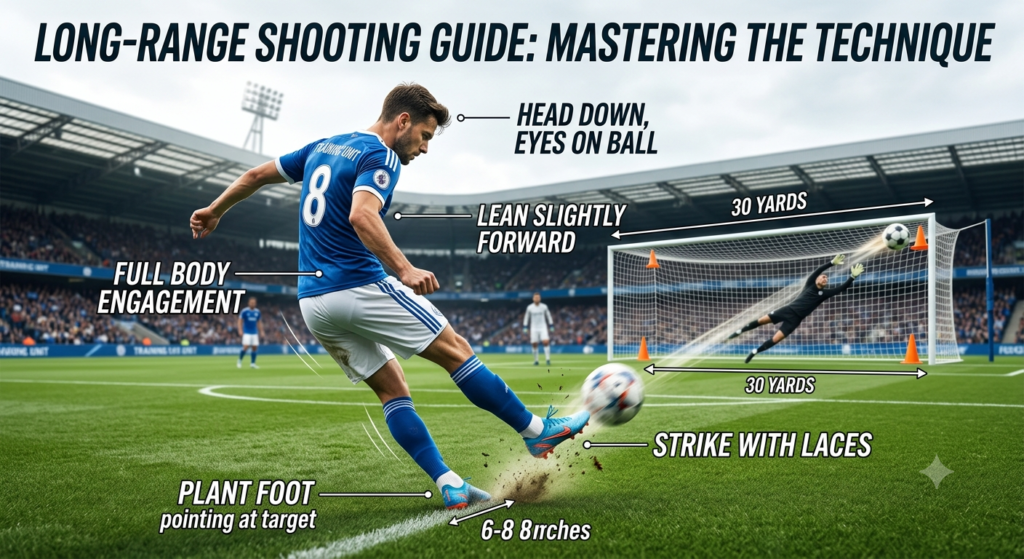
1. Master the Correct Shooting Technique
Technique is more important than raw power.
When preparing to shoot:
- Keep your eyes on the ball.
- Lean slightly forward.
- Plant your non-kicking foot beside the ball.
- Strike through the center or lower half of the ball.
- Follow through naturally.
Many players lose accuracy because they swing too hard. A clean strike usually beats an uncontrolled powerful shot.
2. Position Your Standing Foot Properly
Your standing foot controls the direction of the shot.
Place it:
- Around 6–8 inches beside the ball
- Pointing toward your target
- Firmly on the ground
If your standing foot points away from goal, your shot will often drift wide.
3. Strike with the Laces
The strongest long-range shots usually come from the laces area of the boot.
Advantages include:
- Maximum power
- Better ball speed
- Cleaner contact
- Reduced spin when needed
Avoid striking with your toe, as it reduces control.
Different Parts of the Foot
| Foot Area | Best Use |
|---|---|
| Laces | Powerful long shots |
| Inside | Accurate placement |
| Outside | Curved shots |
| Toe | Emergency finishes only |
4. Keep Your Head Down
One of the oldest coaching tips remains one of the best.
Many players lift their head too early to watch the shot, causing them to lean backward.
When this happens:
- The ball rises too high.
- Accuracy decreases.
- Power is wasted.
Focus on the ball until after contact.
5. Use Your Entire Body
Power doesn’t come only from your leg.
A strong shot involves:
- Hip rotation
- Core muscles
- Leg drive
- Balanced upper body
Think of the shot as a full-body movement rather than simply swinging your foot.
6. Build Leg Strength
Stronger legs produce faster shots.
Useful exercises include:
| Exercise | Benefit |
|---|---|
| Squats | Overall leg power |
| Lunges | Stability |
| Bulgarian split squats | Single-leg strength |
| Calf raises | Explosive movement |
| Box jumps | Power generation |
| Sprint intervals | Speed and explosiveness |
Aim to perform strength training two or three times each week.
7. Improve Core Stability
Your core keeps your body balanced during the shot.
Include exercises like:
- Planks
- Side planks
- Russian twists
- Hanging leg raises
- Mountain climbers
A stronger core helps transfer energy from your body into the ball.
8. Practice Accuracy Before Power
Many young players focus only on hitting the ball hard.
Instead:
- Choose a target.
- Shoot with moderate power.
- Hit the target consistently.
- Gradually increase shot speed.
Accuracy should always come first.
Shooting Progression
| Stage | Goal |
|---|---|
| Beginner | Accuracy |
| Intermediate | Accuracy + Power |
| Advanced | Power + Placement + Speed |
9. Learn When to Shoot
Not every opportunity is worth taking.
Good moments include:
- Defender gives space.
- Goalkeeper is off the line.
- Ball sits perfectly.
- Counterattack creates room.
- No passing options are available.
Poor decisions often waste possession.
10. Perfect Your First Touch
A poor first touch usually ruins the shooting opportunity.
A good first touch should:
- Move the ball into space.
- Set up your stronger foot.
- Keep the ball close enough to strike immediately.
Professional players often prepare the shot with the first touch rather than the shot itself.
11. Train Both Feet
Being able to shoot with either foot makes you far less predictable.
Spend extra practice time using your weaker foot.
Even simple drills like passing and shooting can build confidence over time.
12. Practice Under Pressure
During matches, defenders won’t give you unlimited time.
Create realistic drills:
- One-touch shooting
- Defender closing down
- Timed shooting challenges
- Limited touches
- Shooting after sprinting
These exercises improve decision-making and composure.
Sample Weekly Shooting Plan
| Day | Training Focus |
|---|---|
| Monday | Technique |
| Tuesday | Strength training |
| Wednesday | Long-range shooting |
| Thursday | Recovery |
| Friday | Match simulation |
| Saturday | Game or small-sided matches |
| Sunday | Light recovery |
Common Long-Range Shooting Mistakes
Many players make the same errors repeatedly.
| Mistake | Solution |
|---|---|
| Leaning backward | Lean slightly forward |
| Looking up too early | Keep eyes on the ball |
| Swinging too hard | Focus on clean contact |
| Weak standing foot | Plant firmly beside the ball |
| Poor balance | Strengthen core muscles |
| Shooting from impossible angles | Improve decision-making |
Drills to Improve Long Shots
Target Practice
Place cones in the corners of the goal.
Take 20 shots trying to hit each target.
Distance Challenge
Shoot from:
- 18 yards
- 22 yards
- 25 yards
- 30 yards
Increase distance only after maintaining good accuracy.
Moving Ball Drill
Receive a pass.
Take one touch.
Shoot immediately.
This simulates real match situations.
Rebound Drill
Shoot.
Collect the rebound quickly.
Shoot again.
This improves reactions and finishing.
Mental Preparation
Confidence plays a major role in successful long-range shooting.
Before shooting:
- Stay relaxed.
- Pick your target early.
- Trust your technique.
- Commit fully.
Hesitation often leads to weak, inaccurate efforts.
Nutrition and Recovery
Powerful shooting also depends on physical condition.
Focus on:
- Drinking enough water
- Eating balanced meals
- Getting sufficient protein
- Sleeping 7–9 hours each night
- Stretching after training
Recovery allows muscles to adapt and become stronger.
Final Thoughts
Long-range shooting is one of football’s most rewarding skills. While spectacular goals may look effortless, they are built on hundreds of hours of practice, proper technique, and smart decision-making. Rather than relying solely on power, successful players combine balance, accuracy, timing, and confidence to strike the ball effectively.
By working consistently on your shooting mechanics, strengthening your body, and practicing realistic game situations, you’ll gradually become more comfortable taking shots from distance. Improvement won’t happen overnight, but steady training will help you develop a stronger, more reliable shot that can make a real difference on the pitch.
