


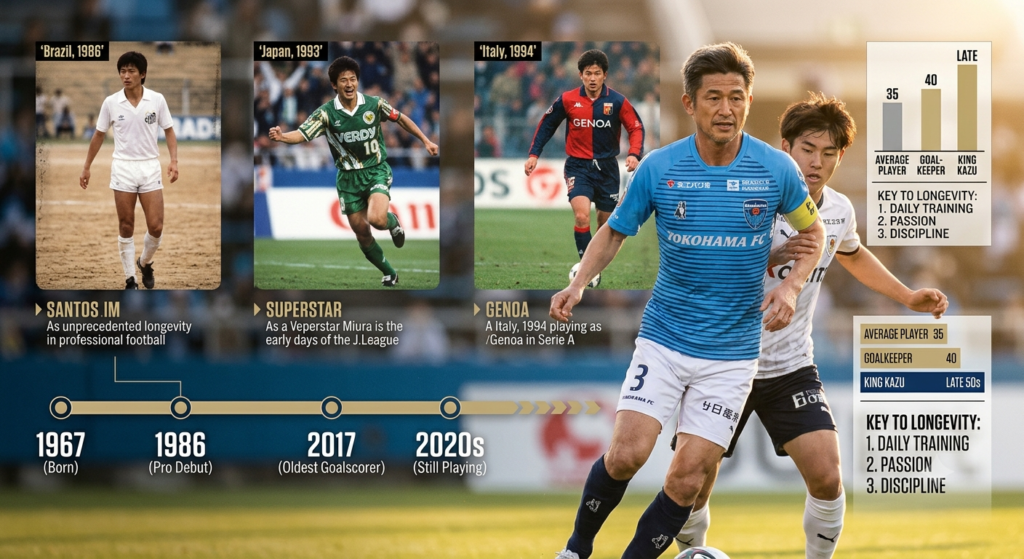
Age is often seen as one of the biggest challenges in professional football. Most players retire in their mid-30s after years of intense training, injuries, and competition. Yet a small number of footballers have defied expectations by continuing to play well into their 40s, 50s, and even beyond.
Among them, one name stands above the rest—Kazuyoshi Miura, affectionately known as “King Kazu.” His extraordinary longevity has made him one of the most respected figures in football history. While many of his contemporaries became coaches or retired from the sport decades ago, Miura continued to play professionally, inspiring football fans across the world.
In this article, we’ll explore the oldest football player ever, examine his remarkable career, compare him with other long-serving players, and discover the secrets behind such incredible longevity.
Who Is the Oldest Football Player Ever?
The title of the oldest professional football player is widely associated with Kazuyoshi Miura of Japan, who continued playing professional football in his late 50s.
Nicknamed “King Kazu,” Miura began his professional career in the 1980s and remained active for decades, an achievement rarely seen in modern football.
Quick Facts
| Detail | Information |
|---|---|
| Full Name | Kazuyoshi Miura |
| Nickname | King Kazu |
| Nationality | Japanese |
| Position | Forward |
| Professional Debut | 1986 |
| Famous For | Longest professional football career |
Player Profile
| Category | Details |
|---|---|
| Country | Japan |
| Preferred Foot | Right |
| Position | Striker |
| Professional Career | Nearly four decades |
| Clubs Played For | Multiple clubs in Japan, Brazil, Europe, and Australia |
His career has stretched across different generations of football, allowing him to compete against players young enough to be his grandchildren.
How Old Was the Oldest Football Player?
Kazuyoshi Miura continued appearing in professional matches well beyond the age at which most footballers retire.
To understand how remarkable that is, compare the typical retirement age with Miura’s playing career.
| Player Type | Average Retirement Age |
|---|---|
| Professional Footballer | 34–36 years |
| Goalkeepers | 37–40 years |
| King Kazu | Late 50s |
Age Difference Calculation
Let’s compare a typical retirement age of 35 years with Miura playing at 58 years.
58 − 35 = 23 years
That means he continued his professional career for more than two decades longer than the average footballer.
Early Life and Love for Football
Kazuyoshi Miura was born on February 26, 1967, in Shizuoka, Japan.
Unlike many Japanese footballers of his generation, he chose an unusual path by moving to Brazil as a teenager to develop his skills. At that time, Brazil was already famous for producing world-class football talent.
Living in a football-obsessed country helped Miura improve his technique, creativity, and understanding of the game. Those experiences shaped the playing style that would later make him one of Japan’s biggest football stars.
Beginning of a Historic Career
Miura signed his first professional contract in Brazil before returning to Japan, where he became one of the country’s first football superstars.
His arrival coincided with the rapid growth of professional football in Japan, and he quickly became one of the faces of the newly formed J.League.
During the early years of his career, he was known for:
- Excellent finishing
- Intelligent movement
- Quick acceleration
- Strong leadership
- Technical ability
These qualities helped him score goals consistently while attracting large crowds to stadiums.
Clubs Throughout His Career
One reason Miura’s career is so fascinating is the number of clubs and countries he represented.
| Country | Examples of Clubs |
|---|---|
| Brazil | Santos (youth connections), Palmeiras-related early career, and other Brazilian clubs |
| Japan | Verdy Kawasaki, Yokohama FC |
| Croatia | Dinamo Zagreb (then Croatia Zagreb) |
| Australia | Sydney FC |
| Portugal | Loan spell later in his career |
His willingness to embrace new challenges kept his career fresh and demonstrated his enduring passion for the game.
Why Is King Kazu So Famous?
Many players are remembered for trophies or records, but Miura is admired for something even rarer—his longevity.
Fans respect him because he proved that discipline, fitness, and love for football can extend a career far beyond normal expectations.
Reasons Behind His Success
| Quality | Impact |
|---|---|
| Fitness | Reduced injuries |
| Professionalism | Consistent performance |
| Experience | Better decision-making |
| Discipline | Long-lasting career |
| Passion | Continued motivation |
Career by the Numbers
Although statistics changed throughout his long career, the overall picture is remarkable.
| Achievement | Approximate Figure |
|---|---|
| Professional Debut | 1986 |
| Professional Career | Nearly 40 years |
| Clubs Represented | Multiple |
| Countries Played In | 5+ |
| Professional Matches | Hundreds |
These numbers alone explain why King Kazu is considered one of football’s greatest examples of longevity.
International Career With Japan
Kazuyoshi Miura wasn’t just a club legend—he also played a major role in the development of Japanese football on the international stage.
During the late 1980s and early 1990s, Japan was still establishing itself as a competitive football nation. Miura became one of the team’s biggest stars, helping raise the profile of the sport across the country.
Although he never played in a FIFA World Cup finals tournament, his influence on Japanese football remains enormous. Many younger players credit him as one of the pioneers who inspired future generations.
Japan National Team Statistics
| Category | Details |
|---|---|
| National Team | Japan |
| International Career | 1990–2000 |
| Position | Forward |
| Goals | 50+ International Goals |
| Major Achievement | One of Japan’s greatest goal scorers |
Other Oldest Football Players in History
While King Kazu is widely recognized for his remarkable longevity at the professional level, several other players have also enjoyed exceptionally long careers.
| Player | Country | Played Into Their |
|---|---|---|
| Kazuyoshi Miura | Japan | Late 50s |
| Essam El-Hadary | Egypt | Mid-40s |
| Gianluigi Buffon | Italy | Mid-40s |
| Peter Shilton | England | Late 40s |
| Roger Milla | Cameroon | Early 40s |
Each of these players showed that experience can sometimes be just as valuable as youth.
Why Goalkeepers Often Play Longer
One interesting trend in football is that goalkeepers usually enjoy longer careers than outfield players.
Why?
- Less sprinting over long distances
- Fewer explosive runs
- Greater reliance on positioning
- Experience improves decision-making
- Physical workload differs from attackers and midfielders
That’s why legendary goalkeepers such as Gianluigi Buffon and Essam El-Hadary remained active well into their 40s.
What Allowed King Kazu to Play for So Long?
Playing professional football for almost four decades requires much more than talent.
Miura followed a disciplined lifestyle throughout his career.
His Success Factors
| Habit | Benefit |
|---|---|
| Daily Training | Maintained fitness |
| Balanced Nutrition | Faster recovery |
| Stretching | Reduced injuries |
| Mental Focus | Long-term consistency |
| Passion for Football | Constant motivation |
Even in his later years, he reportedly trained with the same professionalism as much younger teammates.
Comparing Career Lengths
The difference between an average footballer’s career and King Kazu’s career is extraordinary.
| Career Type | Approximate Length |
|---|---|
| Average Professional Career | 15 Years |
| Elite Long Career | 20 Years |
| King Kazu | Nearly 40 Years |
Career Calculation
Average career:
35 (retirement age) − 20 (professional debut) = 15 years
King Kazu:
2025 − 1986 = 39 years (approximate)
That is more than double the length of a typical professional football career.
Records Held by King Kazu
Throughout his remarkable journey, Miura has achieved several milestones that few players are likely to match.
Notable Achievements
- One of the oldest active professional footballers in history.
- One of Japan’s greatest football pioneers.
- Played professionally across multiple decades.
- Competed in several different countries.
- Inspired generations of Asian footballers.
His legacy extends beyond statistics—he helped popularize football in Japan during the early years of the professional J.League.
Challenges of Playing Football at an Older Age
Remaining competitive after the age of 40 is incredibly difficult.
Older players often face:
- Slower recovery after matches
- Increased injury risk
- Reduced speed
- Greater physical demands
- Stronger and younger opponents
Players who continue at a high level must adapt their style of play, relying more on positioning, experience, and decision-making than pure athleticism.
How Football Has Changed During His Career
One of the most fascinating aspects of Miura’s career is the number of changes he witnessed.
| Then | Now |
|---|---|
| Limited sports science | Advanced performance analysis |
| Basic fitness programs | Individualized conditioning |
| Few tracking systems | GPS performance monitoring |
| Traditional tactics | Data-driven strategies |
| Minimal VAR technology | Video Assistant Referee (VAR) |
Despite these changes, Miura successfully adapted and continued playing in the modern era.
Inspiration for Young Footballers
King Kazu’s story offers valuable lessons beyond football.
Young players can learn the importance of:
- Hard work
- Discipline
- Consistency
- Respect for teammates
- Continuous improvement
- Loving the game regardless of age
His career proves that while talent opens doors, dedication is what keeps them open for decades.
Career Timeline of Kazuyoshi Miura
King Kazu’s football journey has spanned generations. Here’s a look at some of the key milestones in his remarkable career.
| Year | Milestone |
|---|---|
| 1967 | Born in Shizuoka, Japan |
| 1982 | Moved to Brazil to pursue football |
| 1986 | Began his professional career |
| Early 1990s | Became one of Japan’s biggest football stars |
| 1993 | Helped popularize the newly formed J.League |
| 1990–2000 | Represented the Japan national team |
| 2005 | Joined Yokohama FC |
| 2017 | Became one of the oldest players to score in a professional league match |
| 2020s | Continued playing professionally through loan spells and club appearances |
Comparing Legendary Veteran Footballers
While King Kazu is famous for his extraordinary longevity, several other players also enjoyed exceptionally long careers.
| Player | Country | Position | Approximate Playing Age |
|---|---|---|---|
| Kazuyoshi Miura | Japan | Forward | Late 50s |
| Essam El-Hadary | Egypt | Goalkeeper | Mid-40s |
| Gianluigi Buffon | Italy | Goalkeeper | Mid-40s |
| Peter Shilton | England | Goalkeeper | Late 40s |
| Roger Milla | Cameroon | Forward | Early 40s |
This comparison highlights just how unusual Miura’s career has been, especially as an outfield player.
Interesting Facts About King Kazu
- He left Japan as a teenager to learn football in Brazil.
- He has played professional football across four different decades.
- His nickname, “King Kazu,” is recognized by football fans around the world.
- He inspired many young Japanese players who later competed in Europe’s top leagues.
- He continued playing professionally at an age when most players have long since retired.
- His dedication to training and recovery became a model for younger teammates.
What Makes His Legacy Special?
Statistics tell only part of the story. Miura’s greatest achievement is the example he set for future generations.
His career demonstrates that success isn’t only measured by trophies or individual awards. Commitment, discipline, and a genuine love for the game can leave an equally lasting impact.
For Japanese football, King Kazu represents a bridge between the amateur era and the country’s rise as a respected football nation. His influence can still be seen in the success of Japanese players competing in Europe’s biggest leagues today.
Conclusion
The story of Kazuyoshi Miura, the oldest football player ever, is one of the most inspiring in the history of the sport. Beginning his professional career in 1986 and continuing to play for decades afterward, he has redefined what is possible in football.
While most professionals retire in their mid-30s, King Kazu’s commitment to fitness, discipline, and continuous improvement allowed him to enjoy a career that has spanned generations. Beyond his records, he helped shape the development of Japanese football and inspired countless players to pursue their dreams.
Whether you’re a lifelong football fan or just discovering the game, King Kazu’s journey is a powerful reminder that passion and perseverance can create a legacy that lasts far beyond the final whistle.
