


Football is often associated with fast attacks, spectacular goals, and high pressing, but some of the most successful teams in history have built their success on outstanding defending. One tactical approach that has become increasingly popular in modern football is the low block.
Whether it’s an underdog trying to frustrate a stronger opponent or an elite team protecting a narrow lead, the low block remains one of the most effective defensive systems in the game. While some fans view it as a cautious strategy, coaches appreciate it because it requires discipline, teamwork, and excellent positioning rather than relying solely on individual talent.
In this guide, we’ll explain what a low block is, how it works, why teams use it, and what makes it such a difficult system to break down.
What Is a Low Block in Football?
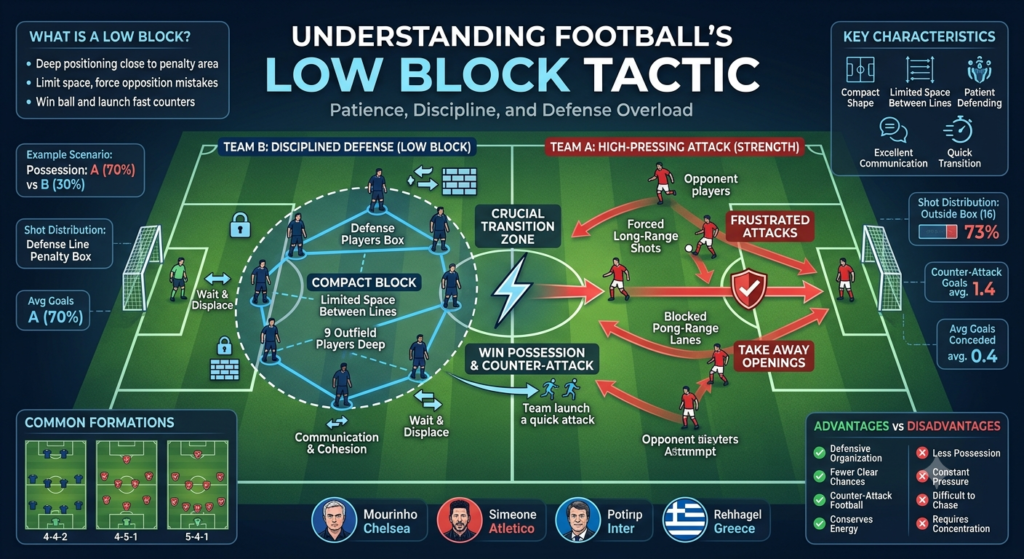
A low block is a defensive tactic in which a team positions most of its players deep inside its own half, usually close to its penalty area. Instead of pressing opponents high up the pitch, the team stays compact, limits space, and forces the opposition to attack through crowded areas.
The primary objective is simple:
- Protect the goal.
- Prevent clear scoring opportunities.
- Force opponents into mistakes.
- Win possession and launch quick counter-attacks.
Unlike high-pressing football, a low block focuses on patience and defensive organization. Players move together as a unit, making it difficult for attackers to find space between the lines.
Why Is It Called a “Low Block”?
The term “block” refers to the team’s defensive shape, while “low” describes where that shape is located on the field.
Instead of defending near the halfway line, players retreat toward their own penalty box. This creates a compact defensive block that is hard to penetrate.
Think of it as building a defensive wall in front of the goalkeeper. Every player understands their position, leaving very little room for opponents to exploit.
How Does a Low Block Work?
When a team loses possession, players quickly drop back into defensive positions instead of immediately trying to win the ball high up the pitch.
The defensive line stays close to the penalty area, while midfielders remain just ahead of them. The distance between defenders and midfielders is kept as small as possible, making passing lanes difficult to find.
Rather than chasing the ball aggressively, players wait for the right moment to challenge, intercept a pass, or force an error.
Typical Defensive Sequence
| Step | Defensive Action |
|---|---|
| 1 | Team loses possession |
| 2 | Players retreat into their defensive shape |
| 3 | Defensive and midfield lines stay compact |
| 4 | Opponent is forced to play around the block |
| 5 | Defenders intercept, tackle, or clear the ball |
| 6 | Team launches a counter-attack |
This organized structure reduces the chances of opponents creating high-quality scoring opportunities.
Key Characteristics of a Low Block
Although every coach has a slightly different approach, successful low-block teams usually share several common characteristics.
1. Compact Defensive Shape
The team stays narrow both vertically and horizontally.
Players avoid leaving large gaps that attackers can exploit.
2. Limited Space Between the Lines
One of the biggest strengths of a low block is minimizing the distance between defenders and midfielders.
When attackers receive the ball, they are immediately surrounded by multiple defenders.
3. Patient Defending
Instead of diving into tackles, defenders remain calm.
They wait for attackers to make mistakes before attempting to win possession.
4. Excellent Communication
Because players defend as a unit, constant communication is essential.
Center-backs organize the back line, while midfielders help track runners and close passing lanes.
5. Quick Transition
Winning the ball is only the first step.
The best low-block teams quickly switch from defense to attack, often catching opponents out of position.
Fast forwards and wingers become crucial during these transitions.
Common Formations Used for a Low Block
Several formations work well with this defensive style.
| Formation | Defensive Strength | Counter-Attacking Potential |
|---|---|---|
| 4-4-2 | Excellent | Very Good |
| 4-5-1 | Excellent | Good |
| 5-4-1 | Outstanding | Good |
| 5-3-2 | Very Good | Very Good |
Each formation has its strengths, but they all share the same goal—keeping the defensive shape compact.
Player Responsibilities in a Low Block
Every player contributes to defending, not just the back four.
| Position | Main Responsibility |
|---|---|
| Goalkeeper | Organize the defense and stop shots |
| Center-Backs | Clear crosses, block shots, win aerial duels |
| Full-Backs | Prevent crosses and defend wide areas |
| Defensive Midfielder | Protect the back line and intercept passes |
| Central Midfielders | Close passing lanes and support defenders |
| Wingers | Track opposition full-backs and help defend |
| Striker | Hold the ball after turnovers and start counter-attacks |
Unlike attacking systems where players often specialize, a low block requires everyone to defend together.
Benefits of Playing a Low Block
Many successful coaches choose this tactic because of its defensive reliability.
Difficult to Break Down
When ten outfield players defend close together, opponents have very little room to create chances.
Protects Against Fast Attacks
Keeping players behind the ball makes it harder for opponents to exploit space with quick through passes.
Encourages Counter-Attacks
Because the opposition usually commits many players forward, winning possession often creates space for fast breaks.
Reduces Defensive Errors
Compact positioning means defenders receive support quickly, reducing the chances of being isolated in one-on-one situations.
Effective Against Stronger Teams
Underdogs frequently use a low block to frustrate technically superior opponents.
By staying organized and disciplined, they can remain competitive even when facing teams with greater possession and attacking quality.
Example Scenario
Imagine Team A is playing against a stronger opponent that controls 70% of the possession.
Instead of pressing high, Team A adopts a low block.
- The defensive line stays just outside the penalty area.
- Midfielders sit only a few yards in front of the defenders.
- Wingers track back to help the full-backs.
- The lone striker waits near the halfway line for counter-attacking opportunities.
The stronger team enjoys plenty of possession but struggles to create clear chances because every dangerous area is heavily protected.
When Team A wins the ball, a quick forward pass allows the striker and wingers to attack the open space left by the opposition.
This simple approach explains why the low block continues to be one of football’s most respected defensive strategies.
Advantages of a Low Block
The low block has become one of football’s most effective defensive systems because it allows teams to stay organized while limiting the opposition’s attacking opportunities. Although it often results in less possession, many coaches believe that defending well is just as important as attacking.
Below are some of the biggest advantages of using a low block.
1. Excellent Defensive Organization
A low block keeps players close together, making it difficult for opponents to find space between the defensive and midfield lines.
Instead of defending individually, the entire team works as one compact unit.
2. Fewer Clear-Cut Chances for Opponents
Because the penalty area is crowded with defenders, attackers are often forced into taking long-range shots or crossing the ball from wide areas.
Both options generally have a lower success rate than creating chances inside the box.
3. Ideal for Counter-Attacking Football
When opponents commit many players forward, they naturally leave space behind their defense.
After winning possession, the defending team can quickly attack these open areas.
Fast wingers and strikers become extremely valuable in this style of play.
4. Conserves Energy
Unlike high pressing, which requires players to sprint constantly, a low block focuses more on positioning than chasing the ball.
This allows players to maintain their energy throughout the match.
5. Effective Against Stronger Opponents
Smaller clubs often face technically superior teams with better players.
A well-drilled low block can reduce that quality gap by relying on teamwork, discipline, and organization instead of individual brilliance.
Disadvantages of a Low Block
Despite its strengths, the low block isn’t perfect.
Teams must accept certain risks when defending so deep.
Limited Possession
Most teams using a low block spend long periods without the ball.
This means players must remain mentally focused for the entire game.
Constant Defensive Pressure
When the opposition dominates possession, defenders face repeated attacks.
Even the best defensive structure can eventually break under continuous pressure.
Difficult to Recover After Conceding
If a team falls behind, it often has to abandon the low block and attack more aggressively.
Some squads struggle to change their tactical approach during a match.
Heavy Reliance on Concentration
One missed marking assignment or poor clearance can undo an otherwise excellent defensive performance.
Discipline is essential from the first whistle to the last.
Advantages vs Disadvantages
| Advantages | Disadvantages |
|---|---|
| Strong defensive organization | Less possession |
| Difficult to break down | Constant pressure |
| Excellent for counter-attacks | Hard to chase games |
| Conserves player energy | Requires total concentration |
| Works well against stronger teams | Can invite too many crosses |
Low Block vs Mid Block vs High Block
Every defensive system has a different purpose. The choice often depends on the coach’s philosophy, the quality of the players, and the opponent.
| Feature | Low Block | Mid Block | High Block |
|---|---|---|---|
| Defensive Line | Near penalty area | Around halfway line | High up the pitch |
| Pressing Intensity | Low | Medium | Very High |
| Possession | Usually Lower | Balanced | Usually Higher |
| Counter-Attack Potential | Excellent | Good | Moderate |
| Space Behind Defense | Very Little | Moderate | Large |
| Physical Demands | Medium | Medium | High |
| Risk Level | Low | Moderate | High |
A low block prioritizes defensive security, while a high block focuses on winning possession quickly.
When Should a Team Use a Low Block?
A low block is particularly useful in several situations.
Protecting a Lead
If a team is leading 1-0 with only a few minutes remaining, dropping into a compact defensive shape can make it harder for the opposition to create chances.
Facing Stronger Opposition
When playing against teams with superior technical ability, defending deep can reduce the amount of dangerous space available.
Playing Away From Home
Many teams adopt a more cautious approach in difficult away fixtures where maintaining defensive discipline is especially important.
Playing With Fewer Players
After receiving a red card, teams often switch to a low block because it helps cover for the numerical disadvantage.
Famous Teams That Successfully Used a Low Block
Many successful clubs and national teams have relied on this defensive strategy.
| Team | Coach | Why It Worked |
|---|---|---|
| Chelsea (2014–15) | José Mourinho | Compact defense and deadly counter-attacks |
| Atlético Madrid | Diego Simeone | Discipline, teamwork, and defensive organization |
| Inter Milan (2009–10) | José Mourinho | Excellent structure against stronger opponents |
| Greece (Euro 2004) | Otto Rehhagel | Outstanding defensive discipline throughout the tournament |
These teams proved that defensive football can still produce trophies when executed correctly.
Real Match Example
Imagine a match between Team A and Team B.
Possession Statistics
| Team | Possession |
|---|---|
| Team A | 72% |
| Team B | 28% |
At first glance, Team A appears to dominate the game.
However, Team B uses a disciplined low block.
The defenders remain close together, midfielders protect the space in front of the back line, and the striker waits for counter-attacking opportunities.
Despite having only 28% possession, Team B allows very few clear chances and eventually scores from a fast counter-attack to win 1-0.
This example highlights an important lesson: possession alone does not guarantee victory.
Tactical Calculation
Suppose an attacking team attempts:
- 22 total shots
- 16 shots from outside the penalty area
- 6 shots inside the penalty area
The defending team’s low block forces most efforts from long range.
Shot Distribution
| Shot Type | Number |
|---|---|
| Outside Box | 16 |
| Inside Box | 6 |
| Total Shots | 22 |
Percentage Calculation
Outside-the-box shots:
16 ÷ 22 × 100 = 72.7%
This means nearly 73% of all shots came from less dangerous areas.
That is exactly what a successful low block aims to achieve—forcing opponents into low-percentage shooting opportunities rather than allowing clear chances close to goal.
Key Qualities Needed for a Successful Low Block
A team cannot simply defend deep and expect success. Several qualities are essential.
- Strong communication
- Tactical discipline
- Patience
- Good positioning
- Winning aerial duels
- Blocking shots
- Quick decision-making
- Fast transitions after recovering possession
Teams that master these fundamentals often become extremely difficult to beat, even against technically superior opponents.
How to Beat a Low Block in Football
Breaking down a well-organized low block is one of the toughest challenges in football. Since defenders leave very little space in central areas, teams must be patient and creative rather than forcing risky passes.
Here are some of the most effective ways to overcome a low block.
1. Move the Ball Quickly
Slow passing gives defenders time to stay organized. Fast ball circulation from one side of the pitch to the other forces the defensive block to shift, increasing the chances of creating gaps.
2. Use Width
Stretching the defense is one of the best ways to create space.
Wingers and attacking full-backs can pull defenders out of position by staying wide before delivering crosses or cut-back passes.
3. Make Runs Behind the Defense
Even though a low block sits deep, well-timed runs can still disrupt the defensive shape.
Midfielders arriving late into the penalty area are often difficult to mark.
4. Shoot From Distance
When space inside the penalty area is limited, long-range efforts become an important attacking weapon.
A powerful shot can result in:
- A goal
- A rebound for another attacker
- A corner kick
- A defensive mistake
5. Create Overloads
Having more attacking players than defenders in one area can force defenders to leave their positions.
Quick one-touch passing and intelligent movement often create the opening needed to break through.
Common Mistakes When Playing a Low Block
Although the tactic is highly effective, it only works when every player follows the game plan.
Some common mistakes include:
| Mistake | Possible Result |
|---|---|
| Defenders pushing out too early | Space opens behind the defense |
| Midfield line too far from defenders | Opponents exploit gaps between the lines |
| Poor communication | Free attackers and missed marking assignments |
| Slow counter-attacks | Opponent quickly regains defensive shape |
| Ball watching | Unmarked runners inside the penalty area |
Avoiding these mistakes is just as important as having the right formation.
Low Block Statistics Example
Imagine a team plays five league matches using a low block.
| Match | Goals Conceded | Clean Sheets | Counter-Attack Goals |
| 1 | 0 | Yes | 2 |
| 2 | 1 | No | 1 |
| 3 | 0 | Yes | 1 |
| 4 | 1 | No | 2 |
| 5 | 0 | Yes | 1 |
Total Calculation
- Total goals conceded: 2
- Total clean sheets: 3
- Total counter-attack goals: 7
Average Goals Conceded
2 ÷ 5 = 0.4 goals per match
Conceding less than one goal per game is a strong indicator that the defensive system is working effectively.
Is a Low Block Defensive or Negative?
Some supporters describe the low block as “defensive football,” while others argue it is simply a smart tactical choice.
In reality, the system is neither good nor bad on its own. Its success depends on how well it is executed.
Many of the world’s best teams have used a low block at certain moments—even sides known for attacking football. A coach may choose it to protect a lead, neutralize a dangerous opponent, or maximize the strengths of the squad.
The key point is that a low block is a tactical tool, not a permanent playing style.
Final Thoughts
The low block remains one of football’s most reliable defensive systems. While it may not always produce exciting, end-to-end matches, it demonstrates that organization, teamwork, and tactical awareness can be just as valuable as flair and attacking talent.
A successful low block is far more than simply placing players behind the ball. It requires disciplined positioning, constant communication, patience, and the ability to transition quickly from defense to attack. Teams that master these principles can frustrate technically superior opponents and remain competitive in even the toughest matches.
Whether you’re a coach looking to strengthen your team’s defense, a player trying to understand tactical responsibilities, or a fan eager to learn more about modern football strategies, understanding the low block offers a deeper appreciation of the tactical side of the game. It’s a reminder that winning football matches often depends as much on smart defending as it does on spectacular goals.
