


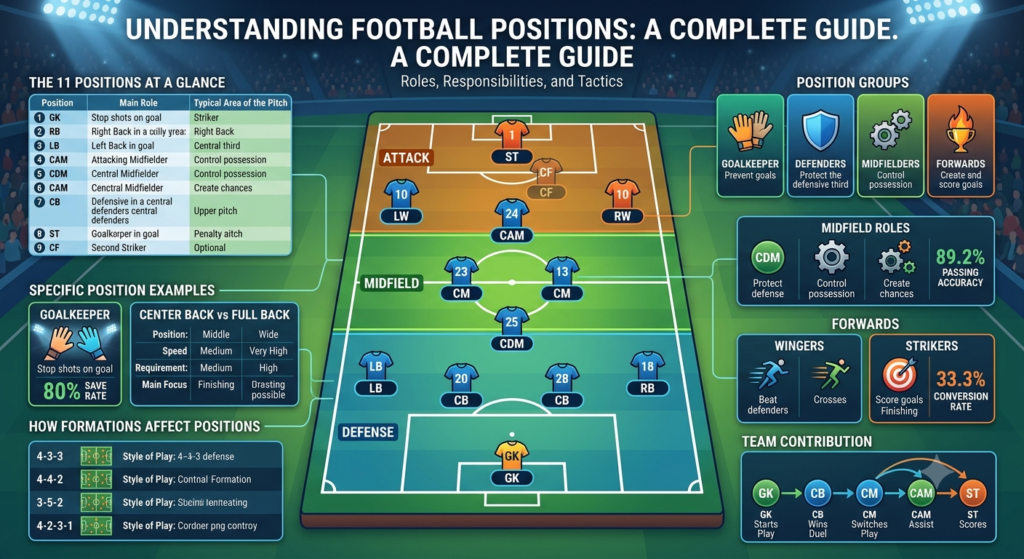
If you’ve ever watched a football match and wondered why some players rarely leave their own half while others spend almost the entire game attacking the opposition, you’re not alone. Football may look simple on the surface, but every player has a specific job that contributes to the team’s overall strategy.
Whether you’re a new fan, a parent learning the game with your child, or an aspiring player hoping to understand where you fit on the pitch, knowing football positions is one of the best places to start.
A standard football team has 11 players, but those 11 players don’t all perform the same role. Some defend the goal, some control possession in midfield, and others focus on creating and scoring goals. Modern football has also become much more flexible, meaning players often contribute in both attack and defense depending on the team’s tactics.
In this guide, we’ll explain every major football position in simple language, describe what each player is expected to do, and help you understand why every role matters.
The 11 Football Positions at a Glance
Before diving into each position, here’s a quick overview of where players are usually located on the field.
| Position | Main Role | Typical Area of the Pitch |
|---|---|---|
| Goalkeeper (GK) | Protect the goal | Penalty area |
| Right Back (RB) | Defend right side | Right defensive flank |
| Left Back (LB) | Defend left side | Left defensive flank |
| Center Back (CB) | Stop attackers | Central defense |
| Defensive Midfielder (CDM) | Shield defenders | Deep midfield |
| Central Midfielder (CM) | Link defense and attack | Center of pitch |
| Attacking Midfielder (CAM) | Create scoring chances | Behind forwards |
| Right Winger (RW) | Attack from the right | Right wing |
| Left Winger (LW) | Attack from the left | Left wing |
| Striker (ST) | Score goals | Opponent’s penalty area |
| Second Striker (CF) (optional) | Support main striker | Between midfield and attack |
Different formations may change the exact positions, but the responsibilities remain largely the same.
Understanding Football Position Groups
Instead of memorizing all 11 positions individually, it helps to divide them into four main categories.
| Group | Primary Objective |
|---|---|
| Goalkeeper | Prevent goals |
| Defenders | Protect the defensive third |
| Midfielders | Control possession and build attacks |
| Forwards | Create and score goals |
Think of a football team like a well-organized company. Every department has a different responsibility, but success depends on everyone working together.
Goalkeeper (GK)
The goalkeeper is the only player allowed to use their hands during open play, but only inside their own penalty area. Their main responsibility is to stop the opposing team from scoring.
Although many people think goalkeepers only make saves, modern football demands much more. Today’s keepers often begin attacks by distributing the ball accurately to defenders or midfielders. They’re also expected to organize the defense, communicate constantly, and make quick decisions under pressure.
A confident goalkeeper gives the entire team more stability.
Main Responsibilities
- Stop shots on goal
- Catch or punch crosses
- Organize defenders
- Distribute the ball accurately
- Sweep behind the defensive line when necessary
Skills Every Goalkeeper Needs
| Skill | Why It Matters |
|---|---|
| Reflexes | React quickly to shots |
| Positioning | Cover the goal efficiently |
| Communication | Organize defenders |
| Handling | Secure the ball safely |
| Distribution | Start attacks accurately |
Goalkeeper Statistics Example
Imagine a goalkeeper faces 10 shots during a match.
| Statistic | Number |
|---|---|
| Shots Faced | 10 |
| Saves Made | 8 |
| Goals Conceded | 2 |
Save Percentage Calculation
Formula
Save Percentage = (Saves ÷ Shots Faced) × 100
Calculation:
= (8 ÷ 10) × 100
= 80% Save Rate
This simple calculation helps coaches evaluate goalkeeper performance over an entire season.
Defenders
Defenders play closest to their own goal and work together to stop attacks before they become dangerous.
While defending remains their main job, today’s defenders also help start attacks by passing confidently from the back.
Most teams use four defenders, although formations with three or five defenders are also common.
Center Back (CB)
The center backs stand in the middle of defense and usually face the opposition’s strongest attackers.
They must remain calm under pressure, win aerial battles, block shots, and make well-timed tackles. A mistake from a center back often leads directly to a goal-scoring opportunity, so concentration is essential.
Tall, strong, and intelligent players often excel in this role because they frequently compete for headers and physical duels.
Responsibilities
- Mark opposing strikers
- Win headers
- Clear dangerous balls
- Block shots
- Build attacks with short passes
Qualities of a Great Center Back
| Quality | Importance |
|---|---|
| Strength | Win physical battles |
| Positioning | Stay between attacker and goal |
| Tackling | Regain possession cleanly |
| Heading | Defend crosses and corners |
| Composure | Avoid costly mistakes |
Full Backs (Left Back & Right Back)
The full backs play on either side of the defense.
Years ago, they focused almost entirely on defending. Modern football has transformed the role dramatically.
Today’s left and right backs often sprint up the wings to provide crosses, support attacks, and create width before quickly recovering into defensive positions.
Because of this, they are among the fittest players on the pitch.
Main Responsibilities of Full Backs
- Stop opposing wingers
- Win one-on-one duels
- Support attacks
- Deliver crosses
- Track runners
- Recover possession
Center Back vs Full Back
| Feature | Center Back | Full Back |
|---|---|---|
| Position | Middle of defense | Left or right side |
| Main Focus | Stop central attacks | Defend wide areas |
| Speed Requirement | Medium | Very High |
| Crossing | Rare | Frequent |
| Attacking Runs | Occasional | Regular |
Defensive Contribution Example
Suppose a defender finishes a match with the following numbers:
| Action | Total |
|---|---|
| Tackles Won | 5 |
| Interceptions | 4 |
| Clearances | 8 |
| Blocks | 2 |
Total Defensive Actions
Formula
5 + 4 + 8 + 2 = 19 defensive actions
While goals often grab the headlines, these contributions can be just as important in helping a team keep a clean sheet.
Midfielders: The Engine Room of the Team
If defenders provide the foundation and forwards deliver the finishing touch, midfielders are the players who keep everything connected. They spend more time involved in play than anyone else, often covering the greatest distance during a match.
A good midfield controls the tempo of the game. Sometimes that means slowing play down to keep possession, while at other moments it means launching a quick counterattack with one precise pass.
Because of their varied responsibilities, midfielders are usually divided into three main types:
- Defensive Midfielder (CDM)
- Central Midfielder (CM)
- Attacking Midfielder (CAM)
Each role has a unique purpose, even though they often work together throughout the game.
Defensive Midfielder (CDM)
The defensive midfielder plays just in front of the center backs. This position acts as a shield for the defense, breaking up attacks before they become dangerous.
Many fans overlook this role because defensive midfielders rarely score goals. However, coaches often consider them among the most valuable players on the pitch.
A strong CDM reads the game well, intercepts passes, wins tackles, and keeps possession under pressure.
Primary Responsibilities
- Protect the defensive line
- Win tackles and interceptions
- Recover loose balls
- Maintain possession
- Begin attacking moves
Key Skills of a Defensive Midfielder
| Skill | Why It Matters |
|---|---|
| Tackling | Win possession cleanly |
| Positioning | Block passing lanes |
| Vision | Find teammates quickly |
| Strength | Compete physically |
| Composure | Stay calm under pressure |
Central Midfielder (CM)
The central midfielder is often described as the team’s “engine.”
These players move constantly between attack and defense, supporting teammates in every area of the pitch. A complete central midfielder must defend, pass, dribble, press opponents, and occasionally score goals.
Because they are involved in nearly every phase of play, central midfielders usually cover the longest distance during a match.
Responsibilities
- Control possession
- Connect defense with attack
- Create passing options
- Support teammates
- Press opponents
Typical Match Statistics
| Category | Average per Match |
|---|---|
| Passes Attempted | 65 |
| Successful Passes | 58 |
| Distance Covered | 11.8 km |
| Tackles | 4 |
| Chances Created | 3 |
Passing Accuracy Calculation
Suppose a midfielder completes 58 out of 65 passes.
Formula
Passing Accuracy = (Successful Passes ÷ Total Passes) × 100
Calculation
= (58 ÷ 65) × 100
= 89.2% Passing Accuracy
This is one of the most common statistics analysts use to evaluate midfield performance.
Attacking Midfielder (CAM)
The attacking midfielder operates just behind the striker.
Rather than focusing on defending, this player looks for creative opportunities that lead to goals. A clever through ball, a perfectly weighted pass, or a quick dribble can completely change a match.
Some of football’s greatest playmakers have built their reputations in this position because they combine creativity with technical skill.
Main Responsibilities
- Create scoring chances
- Deliver key passes
- Support the striker
- Shoot from distance
- Find space between defenders
Comparing Midfield Roles
| Position | Main Objective | Typical Strength |
|---|---|---|
| CDM | Protect defense | Tackling |
| CM | Control possession | Passing |
| CAM | Create chances | Creativity |
Although each role has different priorities, successful teams need balance across all three.
Forwards: Turning Chances into Goals
Forwards play closest to the opponent’s goal.
Their primary responsibility is simple: score goals.
However, modern attackers do much more than finish opportunities. They press defenders, make intelligent runs, create space for teammates, and contribute defensively when possession is lost.
Most attacking units include a combination of wingers and strikers.
Wingers (LW & RW)
Wingers attack from the left and right sides of the pitch.
Their speed and dribbling ability allow them to beat defenders in one-on-one situations before crossing the ball or cutting inside to shoot.
Modern football often sees inverted wingers—right-footed players on the left wing and left-footed players on the right wing—because this allows them to move inside and shoot with their stronger foot.
Responsibilities
- Beat defenders
- Deliver accurate crosses
- Create goal-scoring chances
- Stretch the opposition’s defense
- Score from wide positions
Winger Performance Example
| Statistic | Match Total |
|---|---|
| Successful Dribbles | 7 |
| Crosses Completed | 5 |
| Chances Created | 4 |
| Assists | 1 |
| Goals | 1 |
These numbers show how a winger can influence a match without dominating possession.
Striker (ST)
The striker is usually the team’s main goal scorer.
While finishing remains their biggest responsibility, today’s strikers must also hold up the ball, combine with teammates, press defenders, and create space for others.
Elite strikers know exactly where to position themselves inside the penalty area. They often score because they anticipate where the ball will arrive before defenders react.
Main Responsibilities
- Score goals
- Finish crosses
- Hold up play
- Link with midfielders
- Press opposing defenders
Essential Skills for a Striker
| Skill | Importance |
|---|---|
| Finishing | Convert chances |
| Positioning | Find space |
| Heading | Score aerial goals |
| Strength | Hold off defenders |
| Composure | Stay calm in front of goal |
Goal Conversion Example
Imagine a striker takes 6 shots during a game and scores 2 goals.
Formula
Goal Conversion Rate = (Goals ÷ Shots) × 100
Calculation
= (2 ÷ 6) × 100
= 33.3% Conversion Rate
A striker who consistently converts around one-third of their chances is generally considered highly effective.
How Formations Affect Football Positions
Although every position has defined responsibilities, formations can slightly change how players perform their roles.
For example, a team using 4-3-3 relies heavily on quick wingers, while a 4-4-2 often uses two strikers working together.
| Formation | Defenders | Midfielders | Forwards | Style of Play |
|---|---|---|---|---|
| 4-3-3 | 4 | 3 | 3 | Wide attacking football |
| 4-4-2 | 4 | 4 | 2 | Balanced and direct |
| 3-5-2 | 3 | 5 | 2 | Midfield control |
| 4-2-3-1 | 4 | 5 | 1 | Possession and creativity |
No formation is automatically better than another. Coaches choose systems based on the players available and the tactics they want to use.
One of the biggest misconceptions in football is that only goal scorers deserve recognition.
In reality, every goal usually starts much earlier.
A goalkeeper may begin the attack with an accurate pass. A defender wins possession. A midfielder controls the tempo and plays a clever through ball. Finally, the striker finishes the move.
Without each step, the goal never happens.
This teamwork is one of the reasons football remains the world’s most popular sport.
Example of Team Contribution
Imagine a team scores one goal after the following sequence:
| Player | Contribution |
|---|---|
| Goalkeeper | Starts play with a long pass |
| Center Back | Wins the aerial duel |
| Central Midfielder | Keeps possession and switches play |
| Attacking Midfielder | Provides the assist |
| Striker | Scores the goal |
Although only one player receives credit for the goal, every teammate played an important role in creating it.
Final Thoughts
Understanding football positions makes watching—and playing—the game far more enjoyable. Once you recognize what each player is responsible for, you’ll begin to notice the tactical battles happening all over the pitch, not just around the ball.
From the goalkeeper organizing the defense to the striker looking for the winning goal, every position has a purpose. Modern football rewards teamwork, intelligence, and discipline just as much as individual talent.
Whether you’re following the Premier League, La Liga, the Champions League, or a local youth match, knowing the responsibilities of each position helps you appreciate the sport on a deeper level.
The next time you watch a match, try focusing on one position for a few minutes instead of only following the ball. You’ll quickly discover how much work every player does to help the team succeed.
