


If you have watched cricket for the first time, you have probably heard an umpire shout “LBW” after the ball hits a batter’s pads. For many beginners, LBW in cricket can be one of the most confusing rules to understand. A ball hits the batter’s leg, the fielding team appeals, and suddenly everyone is waiting for the umpire’s decision.
LBW stands for Leg Before Wicket. Despite the name, a batter is not automatically out every time the ball hits their leg. Several conditions have to be satisfied before an umpire can give the batter out LBW.
This guide explains cricket LBW Explained rules for beginners in straightforward language, including how the rule works, what the umpire looks for, common misconceptions, and how technology is used to review close decisions.
What Does LBW Mean in Cricket?
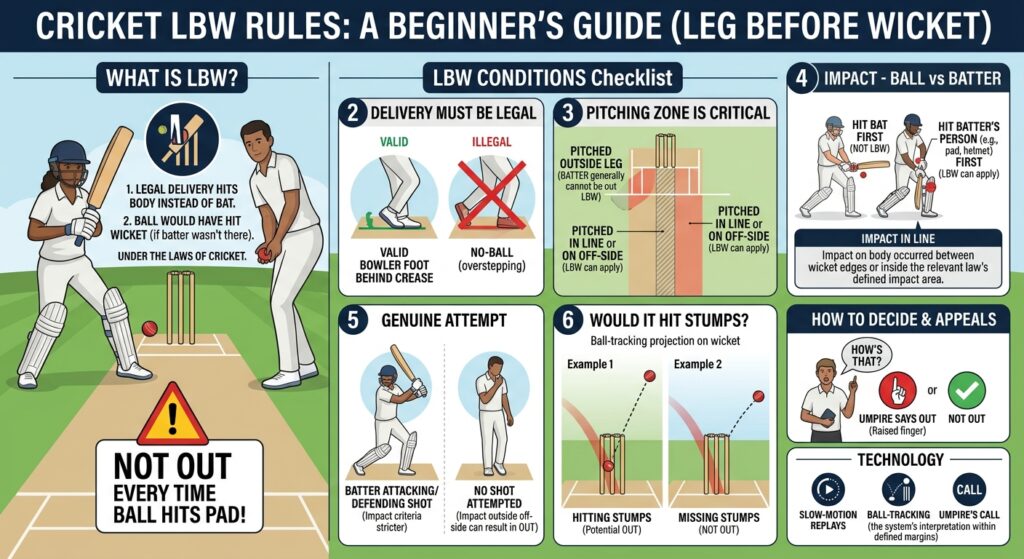
LBW means Leg Before Wicket. The basic idea is that a batter can be dismissed when a legal delivery hits their body instead of their bat and, under the conditions set out in the Laws of Cricket, the ball would have gone on to hit the wicket.
The rule prevents a batter from simply using their body to stop deliveries that would otherwise hit the stumps.
However, LBW is more complicated than saying:
Ball hits leg = batter is out.
That is not correct.
For an LBW dismissal to occur, the umpire has to consider several factors. These include where the ball pitched, where it hit the batter, whether the batter played a genuine shot, and whether the ball would have hit the stumps.
The Basic LBW Conditions
For beginners, it helps to think about LBW as a checklist.
The umpire generally considers:
- Was the delivery legal?
- Did the ball pitch in an area permitted by the LBW law?
- Did the ball hit the batter’s person rather than the bat first?
- Where did the ball hit the batter?
- Was the batter attempting a genuine shot?
- Would the ball have hit the wicket?
These conditions work together. If the required conditions are not satisfied, the batter should not be given out LBW.
Does the Ball Have to Hit the Leg?
No.
Despite the words “Leg Before Wicket,” the ball can strike other parts of the batter’s body. The important point is that the ball must make contact with the batter’s person, rather than the bat first, and the other LBW requirements must also be satisfied.
For example, the ball could strike a batter’s pad and potentially result in LBW. But if it hits the bat first and then touches the pad, an LBW dismissal is generally not possible from that delivery.
This is one reason slow-motion video can make LBW decisions look complicated.
Where Does the Ball Need to Pitch?
Where the ball pitches is one of the most important parts of an LBW decision.
If the ball pitches outside the leg side of the batter’s wicket, the batter generally cannot be given out LBW under the standard law, subject to the specific conditions of the law.
This is often described by commentators as “pitched outside leg.”
On the other hand, a delivery that pitches in line with the wickets or on the off side can potentially satisfy this part of the LBW law.
For beginners, remember:
Pitching outside leg side can prevent an LBW dismissal.
That is why you may sometimes see a batter hit on the pads and immediately hear commentators discussing where the ball pitched.
What Does “In Line” Mean?
When commentators say that the ball struck the batter “in line,” they are talking about its position relative to the wicket.
Imagine the three stumps behind the batter. The umpire has to determine whether the impact of the ball on the batter’s person occurred in an area covered by the LBW law.
The batter’s shot also matters.
When the batter is attempting to play a genuine shot, the law applies different requirements to the point of impact than it does when no genuine shot is being attempted.
This distinction is important and is one reason LBW decisions cannot be judged simply by looking at whether the ball hit the pads.
What Is a Genuine Shot?
A genuine attempt to hit the ball with the bat can affect the LBW decision.
For example, imagine a batter moves their bat toward the ball and attempts to defend a delivery. The ball misses the bat and hits the pad.
The umpire then has to consider the relevant LBW conditions, including whether the batter was genuinely attempting to play the ball.
This is different from a batter who makes no genuine attempt to hit the delivery.
The exact legal wording is more detailed than the simple explanation used by commentators, but the distinction is important when learning the rule.
The Most Important Question: Would It Hit the Stumps?
One of the key questions in an LBW decision is whether the ball would have hit the wicket if the batter had not been in the way.
This is why you often hear commentators say:
“Impact is in line, and it was hitting the stumps.”
The umpire is effectively judging what would have happened to the ball after it struck the batter.
If the ball was going to miss the stumps anyway, the batter should not normally be given out LBW.
This makes LBW different from some other dismissals. The umpire is not simply judging what happened at the moment the ball hit the batter. They also have to assess the ball’s projected path.
A Simple LBW Example
Imagine a right-handed batter facing a fast bowler.
The bowler delivers a straight ball.
The batter misses the shot, and the ball hits the front pad.
The ball appears to have been heading directly toward the middle stump.
The fielding team appeals.
The umpire considers:
- The delivery was legal.
- The ball did not pitch outside the relevant leg-side area.
- The ball hit the batter’s pad.
- The conditions relating to the batter’s shot and point of impact are satisfied.
- The ball would have hit the wicket.
If all the required conditions are met, the batter can be given out LBW.
An Example Where LBW Would Not Apply
Now imagine a bowler sends the ball down the leg side.
The ball pitches outside the batter’s leg-side wicket area and then hits the batter’s pad.
The fielding team appeals loudly.
Even though the ball hit the batter’s body, the LBW conditions are not automatically satisfied.
The location where the ball pitched is important, so the umpire may reject the appeal.
This is why a batter can sometimes be struck on the pads without being in danger of an LBW dismissal.
Why Do Bowlers Appeal for LBW?
An LBW appeal can happen very quickly.
A bowler may deliver a straight ball, the batter misses, and the ball hits the pad. The bowler and nearby fielders immediately shout an appeal.
The appeal is essentially asking the umpire to consider whether the batter should be dismissed.
The umpire then makes a decision.
If the umpire raises a finger, the batter is out LBW unless the decision is successfully overturned through a review system where available.
If the umpire says “not out,” the batting team continues.
What Happens When the Umpire Says Not Out?
A “not out” decision does not necessarily end the discussion.
In competitions that use a Decision Review System, the fielding team may be able to challenge the decision by requesting a review, subject to the competition’s review rules.
The third umpire can then examine available technology.
Depending on the situation, this may include slow-motion replays, ball-tracking technology, and other video evidence.
The review process can help determine whether the ball pitched in the relevant area, where it hit the batter, and whether it was projected to hit the stumps.
How Does Ball Tracking Help?
Ball-tracking technology is particularly important for LBW reviews.
It uses information from cameras and computer systems to estimate the path of the ball.
For an LBW review, viewers may see a graphic showing:
- where the ball pitched,
- where the ball struck the batter,
- and where the ball was projected to travel.
The final decision still follows the applicable playing conditions and review procedures.
Technology does not simply make every LBW decision automatic. There are still rules governing how evidence is interpreted.
What Is “Impact”?
You will often hear the word impact during an LBW review.
Impact refers to the location where the ball makes contact with the batter’s person.
The third umpire needs to determine whether that contact occurred in an area that satisfies the LBW law.
Commentators may describe the result using phrases such as:
“Impact in line.”
or:
“Impact outside off.”
Understanding the word “impact” makes cricket broadcasts much easier to follow.
What Is “Umpire’s Call”
Another phrase beginners often hear is “umpire’s call.”
This can occur during a review when the technology indicates that the original on-field decision falls within the applicable margin or threshold used by the review system.
In such circumstances, the original umpire’s decision can remain in place.
For example, a close ball-tracking result might show a small portion of the projected ball overlapping the wicket area, while the system’s review rules classify it as umpire’s call.
The precise use of umpire’s call depends on the competition’s playing conditions and the review protocol.
LBW and the Batter’s Position
A batter’s position can make LBW decisions more difficult.
Batters move their feet, change their stance, come down the pitch, or move across the crease. The umpire has to assess the delivery based on the relevant circumstances at the moment of impact.
A batter who moves across the stumps can create a very different LBW situation from a batter who remains in a conventional position.
This is one reason experienced bowlers try to create situations where the ball attacks the stumps or pads.
Why LBW Is an Important Bowling Weapon
LBW is not just a rule; it is also an important part of bowling strategy.
Fast bowlers often try to bowl straight enough to bring the stumps and pads into play. Swing bowlers can make the ball move after pitching, creating uncertainty for the batter.
Spin bowlers can also use LBW as a weapon. A spinner may tempt a batter to move forward and then beat the bat with a turning delivery.
When the ball hits the pads in front of the wicket, an LBW appeal can follow.
Common LBW Mistakes Beginners Make
Mistake 1: Thinking Every Pad Hit Is Out
This is the most common misunderstanding.
A ball hitting the pad does not automatically mean LBW.
Several conditions must be satisfied.
Mistake 2: Ignoring Where the Ball Pitched
The pitch location is extremely important.
A delivery pitching outside the relevant leg-side area can prevent an LBW dismissal.
Mistake 3: Forgetting the Bat
If the ball hits the bat first and then the batter’s body, it generally cannot result in an LBW dismissal.
Mistake 4: Ignoring the Ball’s Future Path
The ball must satisfy the relevant requirement concerning whether it would have hit the wicket.
A delivery that was going to miss the stumps cannot normally result in LBW simply because it struck the batter.
LBW vs Bowled
It is also useful to understand the difference between LBW and bowled.
A batter is bowled when the ball itself hits the wicket and dislodges the bails, subject to the relevant laws.
With LBW, the batter’s body prevents the ball from reaching the wicket, and the required conditions for LBW are satisfied.
So you can think of it this way:
Bowled: Ball hits wicket.
LBW: Ball hits batter’s person and would have gone on to hit wicket, with all other LBW conditions satisfied.
Final Thoughts
Understanding cricket LBW for beginners becomes much easier when you stop thinking of it as simply “the ball hit the leg.”
LBW is a combination of several factors. The umpire must consider where the ball pitched, whether it struck the batter’s person rather than the bat first, where the impact occurred, whether the batter was attempting a genuine shot, and whether the ball would have hit the wicket.
Once you understand those basic ideas, LBW appeals during a cricket match become much easier to follow.
The next time you see a bowler appeal after hitting the batter’s pad, pay attention to what the commentators say about pitching, impact, and hitting the stumps. Those three ideas will give you a strong foundation for understanding one of cricket’s most interesting rules.
