


Cricket can be a strange sport when you first come across it. A match can last a few hours or several days, the scoreboard uses numbers that do not always look like ordinary decimals, and commentators regularly use words such as wicket, maiden, yorker, crease, innings, and LBW as though everyone already knows what they mean.
For someone watching cricket for the first time, it is perfectly normal to feel a little lost.
The good news is that you do not need to learn every rule before you can enjoy the game. Once you understand the basic idea of scoring runs, taking wickets, bowling overs, and chasing a target, most of what happens on the field starts to make sense.
This cricket for beginners guide explains the important parts of the sport in straightforward language. Whether you have recently started watching international cricket, want to understand a T20 match, or simply want to know what all those numbers on the scoreboard mean, this guide will give you a solid starting point.
What Is Cricket?
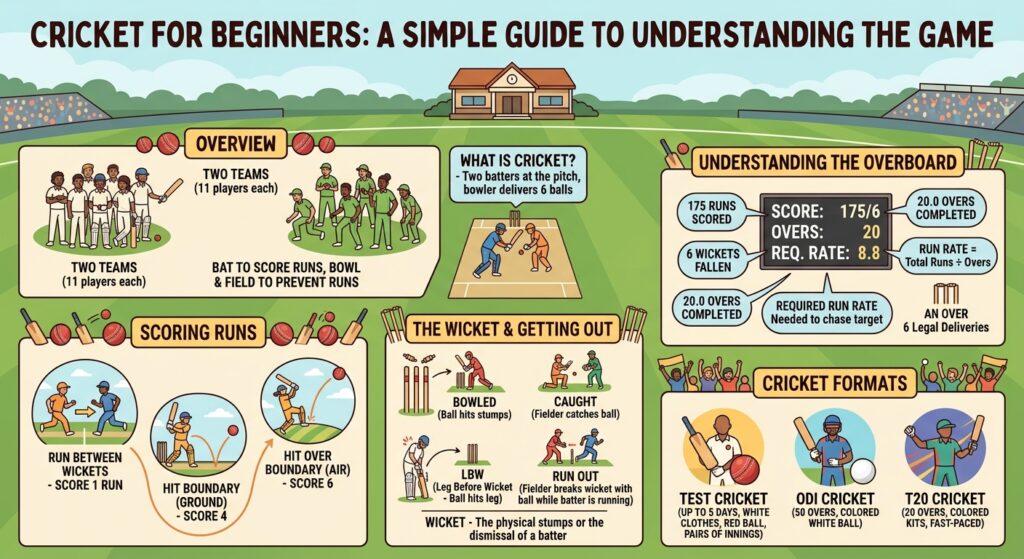
Cricket is a team sport played with a bat and ball. Two teams compete against each other, with each team normally consisting of 11 players.
At the most basic level, one team bats while the other team bowls and fields.
The batting team tries to score as many runs as possible. The fielding team attempts to prevent those runs and dismiss the batters.
After the batting opportunity ends, the teams change roles. The team that finishes with the better score wins, depending on the rules and format of the match.
That sounds simple, but cricket has many different strategies hidden inside this basic idea. A batter may decide whether to attack or defend. A bowler may change speed or direction. A captain may move fielders to particular areas because they expect a certain shot.
This mixture of individual skill and team tactics is one of the reasons cricket has such a large following around the world.
How Many Players Are in a Cricket Team?
A standard cricket team has 11 players.
However, not every player has exactly the same job.
A team may include specialist batters, fast bowlers, spin bowlers, wicketkeepers, and all-rounders. An all-rounder is useful because they can contribute with both bat and ball.
The captain is responsible for making many decisions during the match. These include choosing bowlers, setting the field, deciding the batting order, and responding to changing match conditions.
The wicketkeeper has a special role. They stand behind the batter’s wicket and are responsible for collecting deliveries that pass the batter.
Understanding the Cricket Pitch
The pitch is the rectangular area in the middle of the cricket field.
At each end of the pitch is a wicket made up of three vertical stumps and two small bails.
Two batters are normally on the pitch at the same time. One faces the bowler, while the other waits at the opposite end.
The batter’s position is important because the creases around the wicket determine whether they are safely inside their ground during certain situations.
You will often see a batter touching their bat behind the crease before preparing for the next delivery. This is not just a habit; it can be important when the fielding team is trying to run them out.
How Does a Cricket Innings Work?
An innings is the period during which a team bats.
The number of innings depends on the format.
In Test cricket, each team normally has two innings. In limited-overs formats such as One-Day Internationals and T20 cricket, each team normally has one innings.
The batting side has two batters at the crease. They remain there until one of them is dismissed. When a batter gets out, another batter comes in.
The innings continues until the permitted number of overs is completed, enough wickets have fallen, or another condition ends the innings.
This is why you might see a score such as:
245/6
The first number means the team has scored 245 runs.
The second number means six wickets have fallen.
So the team has 245 runs and has lost six wickets.
What Is an Over?
An over is one of the most important terms for anyone learning cricket.
One over contains six legal deliveries.
A bowler delivers six legal balls and then another bowler normally takes over from the opposite end.
There is an important detail here: cricket does not use decimal overs in the normal mathematical sense.
If the scoreboard says:
14.3 overs
it means:
- 14 complete overs
- 3 legal balls of the next over
It does not mean fourteen and three-tenths overs.
Fourteen completed overs contain:
14 × 6 = 84 balls
Add three more deliveries:
84 + 3 = 87 balls
Therefore, 14.3 overs represents 87 legal deliveries.
Once you understand this, cricket scoreboards become much easier to read.
How Are Runs Scored?
Runs are what the batting team is trying to collect.
The simplest method is for the batter to hit the ball and run between the wickets.
If both batters reach the opposite ends safely, they score one run. They can attempt another run if they believe there is enough time.
For example, if a batter hits the ball into an open area of the field, the batters might complete two runs before the fielders return the ball.
But running is not the only way to score.
Four Runs
If a batter hits the ball and it reaches the boundary after bouncing, the batting team normally receives four runs.
This is called a boundary or a four.
Six Runs
When a batter hits the ball over the boundary without it touching the ground inside the field, the shot is normally worth six runs.
Sixes are especially common in T20 cricket because batters often take greater risks in an attempt to increase the scoring rate.
What Are Extras?
Sometimes the batting team receives runs without those runs being credited to the batter.
These are called extras.
The common types include wides, no-balls, byes, and leg byes.
A wide occurs when a bowler delivers a ball outside the area allowed under the relevant rules, making it difficult or impossible for the batter to play a normal shot.
A no-ball is another type of illegal delivery. The exact reasons a delivery can be called a no-ball vary according to the circumstances.
Byes and leg byes are runs scored when the ball passes the batter without being struck by the bat in the usual way.
Extras are included in the team’s total.
What Is a Wicket?
The word “wicket” can mean several things in cricket.
It can refer to the physical stumps and bails. It can also mean the dismissal of a batter.
When someone says, “The bowler has taken a wicket,” they normally mean that a batter has been dismissed.
Taking wickets is extremely important because a batting team has a limited number of dismissals available before its innings comes to an end.
Common Ways a Batter Gets Out
There are several methods of dismissal, but beginners should start with the most common ones.
Bowled
Bowled is one of the easiest dismissals to understand.
The bowler delivers the ball, and it hits the wicket, causing the bails to be dislodged according to the laws.
A batter can do everything right with their shot selection and still be beaten by a delivery that crashes into the stumps.
Caught
A caught dismissal happens when a fielder catches the ball after the batter has hit it and before the ball touches the ground, subject to the applicable laws.
Catches can be taken close to the wicket, in the outfield, or near the boundary.
Some catches are straightforward. Others require excellent reflexes, balance, and athletic ability.
LBW
LBW stands for Leg Before Wicket.
This is one of the rules that confuses beginners the most.
In simple terms, a batter can be dismissed LBW when the ball hits their body rather than the bat and the conditions required by the law are satisfied.
The umpire has to consider several factors, including where the ball pitched, where it struck the batter, and whether it would have hit the wicket.
You do not need to memorize every detail immediately. After watching more matches, LBW decisions become easier to understand.
Run Out
A run out happens when the fielding team breaks the wicket while a batter is outside their ground during a run.
This often occurs when batters try to steal an extra run and the fielder produces a quick and accurate throw.
Stumped
A stumping generally occurs when the wicketkeeper breaks the wicket while the batter is outside their ground and is not protected by the relevant conditions of the law.
You will often see stumpings when a batter moves forward to attack a spin bowler.
What Does “All Out” Mean?
A team normally has 11 players, but two batters are needed at the crease.
That means a team can generally lose ten wickets before there are no more batting partnerships available.
When the tenth wicket falls, the team is normally all out.
For example:
198/10
means the team scored 198 runs and lost ten wickets.
Meanwhile:
198/5
means the team scored 198 runs but still has five wickets remaining.
That difference can be extremely important, especially in limited-overs cricket.
The Main Cricket Formats
Cricket is played in several formats, but three major international formats are particularly important.
Test Cricket
Test cricket is the longest format.
A Test match can last up to five days, and each side normally has two innings.
This format is about patience, technique, stamina, and long-term strategy.
A batter might spend several hours at the crease. A bowler may work through a long spell, slowly building pressure on a batter.
For some new fans, Test cricket seems slow at first. However, once you understand the tactics, small changes in field placement, bowling angle, and batting technique can become fascinating.
One-Day International Cricket
One-Day International cricket, usually called ODI cricket, gives each team a maximum of 50 overs.
There is a fixed amount of time and deliveries available, so teams have to balance caution with aggression.
An ODI innings often develops in stages. A team may start carefully, increase the scoring rate in the middle overs, and attack heavily toward the end.
T20 Cricket
T20 cricket gives each team a maximum of 20 overs.
It is the shortest of the three major international formats and is designed around fast-paced cricket.
Batters often attack from the beginning because they have only 120 legal deliveries available.
Bowlers use different variations to prevent easy boundaries, while captains constantly adjust their field.
For many beginners, T20 is an accessible way to start watching cricket because matches are relatively short and the action is usually continuous.
How to Read a Cricket Scoreboard
A scoreboard tells you much more than just the team’s total.
Imagine you see:
175/6 after 20 overs
You now know:
- Runs = 175
- Wickets lost = 6
- Overs = 20
- Innings = complete in a standard T20 match
If the opposition is chasing, it needs:
175 + 1 = 176 runs
to win.
The number of wickets remaining also matters.
A team chasing 176 with eight wickets in hand is in a very different position from a team chasing 176 with only two wickets remaining.
What Is Run Rate?
Run rate shows how quickly a team is scoring.
The basic formula is:
Run Rate = Total Runs ÷ Overs
For example, suppose a team scores 96 runs in 12 overs.
96 ÷ 12 = 8 runs per over
The scoring rate is therefore 8.00 runs per over.
Now imagine the team reaches 140 runs after 16 overs.
140 ÷ 16 = 8.75 runs per over
The team has increased its scoring pace.
Required Run Rate
The required run rate is especially important during a chase.
Suppose Team A scores 180 runs.
Team B needs 181 to win.
After 10 overs, Team B has scored 72 runs.
It still needs:
181 – 72 = 109 runs
If ten overs remain:
109 ÷ 10 = 10.9 runs per over
So Team B needs to score at an average of 10.9 runs per over from that point.
This is a simple calculation, but it helps explain why commentators become excited when the required run rate begins climbing.
Important Player Roles
Opening Batters
Opening batters begin the innings.
They face the new ball, which can be challenging because fast bowlers may get movement from the pitch or through the air.
Some opening batters are defensive and patient, while others immediately attack.
Middle-Order Batters
Middle-order players usually come in after the opening partnership.
They may be responsible for rebuilding the innings after wickets or increasing the scoring rate.
Finishers
In limited-overs cricket, a finisher is generally a batter trusted to score quickly toward the end of an innings.
These players often specialize in hitting boundaries under pressure.
Fast Bowlers
Fast bowlers rely on speed, movement, bounce, and accuracy.
They may bowl different lengths depending on the batter and match conditions.
Spin Bowlers
Spin bowlers deliver the ball more slowly but use rotation and variation to deceive the batter.
There are several types of spin bowling, including off-spin and leg-spin.
Wicketkeeper
The wicketkeeper stands behind the batter and receives deliveries from the bowler.
They are involved in catches, stumpings, run-outs, and general communication with the bowling team.
What Is the Toss?
Before the match begins, the captains take part in a toss.
The captain who wins can normally choose whether their team will bat or field first.
This decision may depend on the pitch, weather, dew, team strengths, and expected match conditions.
For example, a captain might prefer to bowl first if they believe the pitch will become easier for batting later.
However, winning the toss does not automatically mean winning the match.
What Is an Appeal?
When fielders believe that a batter is out, they appeal to the umpire.
You may hear the players shout:
“How’s that?”
The umpire then decides whether the batter is out.
In professional cricket, review systems may also be available under the playing conditions. A captain can sometimes ask for an umpire’s decision to be reviewed.
This technology has become an important part of modern international cricket.
Basic Cricket Terms for Beginners
| Term | Simple Explanation |
|---|---|
| Batter | Player who scores runs |
| Bowler | Player who delivers the ball |
| Wicketkeeper | Player behind the stumps |
| Over | Six legal deliveries |
| Innings | A team’s turn to bat |
| Boundary | A four or six |
| Duck | Dismissal without scoring |
| Maiden | Over with no credited runs from the bowler |
| Yorker | Ball aimed near the batter’s feet |
| Bouncer | Short-pitched delivery |
| Partnership | Runs scored by two batters together |
| Extras | Runs not credited directly to the batter |
| Strike | Batter currently facing the delivery |
| Appeal | Request for an umpire to give a batter out |
How Beginners Can Start Watching Cricket
If you are completely new to cricket, do not try to learn everything in one sitting.
Start by watching a short-format match, particularly a T20 game. Keep an eye on the score and try to understand what changes after every ball.
Look at the total score, wickets, overs, and required run rate.
You can also follow one team regularly. Becoming familiar with the players makes the game much easier to understand because you begin to recognize their strengths and weaknesses.
When a commentator uses a word you do not know, look it up later rather than stopping the entire match to learn every rule.
After a few games, you will naturally recognize common terms.
Why Cricket Is More Than Just Batting and Bowling
At first glance, cricket may seem to be mainly about a batter hitting a ball.
There is much more happening underneath.
Captains constantly adjust their plans. Bowlers look for weaknesses. Batters study field placements. Fielders move according to the situation. Coaches analyze previous performances.
Even the condition of the ball can influence the match.
A new ball may behave differently from an older one. Pitch conditions can change. Weather can influence swing and movement. Dew can affect the field and ball later in the day.
This is what makes cricket such a strategic sport.
Final Thoughts
Learning cricket for beginners is mostly about taking one step at a time.
You do not need to know every law of the game before watching a match. Begin with the essentials: runs, wickets, overs, innings, targets, and the difference between batting and bowling.
Once those ideas are clear, the scoreboard becomes easier to understand. Then you can gradually learn about field positions, bowling variations, batting techniques, powerplays, strike rates, and more advanced tactics.
The biggest mistake a new cricket fan can make is worrying about understanding everything immediately. Cricket has been played for centuries, and even experienced supporters continue to discover new details about the game.
Watch a match. Follow the score. Ask questions. Notice why the captain changes the field or why a batter chooses to defend instead of attack.
Eventually, the numbers and terminology will stop looking confusing.
They will start telling you the story of the match.
And that is when cricket becomes much more enjoyable.
