


Youth football is one of the most exciting ways for young athletes to learn teamwork, discipline, confidence, and competitive spirit. Among all the skills required in the game, tackling is one of the most important defensive abilities. A good tackle can stop an opponent’s advance, change the momentum of a match, and help a team achieve victory.
However, youth football tackle is not just about making big hits or stopping a player with maximum force. At a young age, players must learn proper tackling techniques that focus on control, balance, timing, and safety. Coaches, parents, and players all have a responsibility to make the game enjoyable while reducing unnecessary risks. Proper tackling education focuses on body position, keeping the head safe, and using correct contact methods.
This guide explains everything about youth football tackling, including its importance, basic techniques, safety rules, common mistakes, training drills, and how young players can improve their defensive skills.
What Is a Youth Football Tackle?
A youth football tackle happens when a defensive player uses their body and technique to stop an offensive player who has possession of the ball. The main goal of a tackle is to bring the ball carrier to the ground or stop their forward movement.
Unlike professional football, youth football focuses more on learning fundamentals rather than physical dominance. Young players are still developing their strength, coordination, and understanding of the game, so technique is much more important than power.
A successful tackle requires:
- Good positioning
- Proper foot movement
- Strong body control
- Safe contact technique
- Quick decision-making
A player who understands these fundamentals can become an effective defender without depending only on size or strength.
Why Tackling Is Important in Youth Football
Defense plays a major role in football. A team cannot win games only by scoring points; it must also prevent opponents from advancing.
Tackling helps young players develop several important skills:
| Skill | How Tackling Improves It |
|---|---|
| Confidence | Players become comfortable in defensive situations |
| Reaction Time | Players learn to respond quickly |
| Teamwork | Defenders communicate and support each other |
| Discipline | Players understand rules and controlled aggression |
| Physical Ability | Tackling improves balance and body control |
A player who learns tackling correctly at a young age builds a strong foundation for future football development.
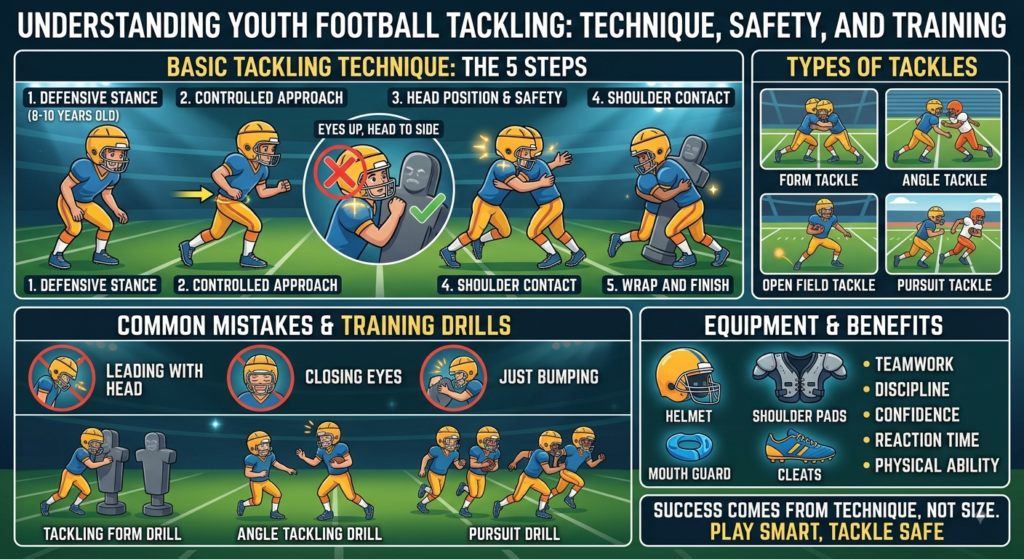
Basic Youth Football Tackling Technique
A proper tackle is a combination of several movements. Young players should practice each step separately before attempting full-speed tackles.
1. Defensive Stance
Every tackle begins with the correct stance.
A good defensive stance includes:
- Feet shoulder-width apart
- Knees slightly bent
- Weight on the front part of the feet
- Eyes focused on the opponent
- Hands ready for contact
A poor stance makes it difficult to react quickly.
2. Approach the Ball Carrier
Many young players make the mistake of running directly at an opponent at full speed. This often allows the ball carrier to avoid the tackle.
Instead, defenders should:
- Stay balanced
- Control their speed
- Keep their body square
- Watch the opponent’s hips
The hips usually reveal the direction a runner wants to move.
3. Head Position and Safety
One of the most important parts of modern tackling instruction is protecting the head. Players should avoid leading with the helmet or lowering their head during contact.
Safe tackling encourages:
- Eyes up
- Head positioned to the side
- Shoulder contact instead of head-first contact
- Controlled body movement
Unsafe techniques such as helmet-first tackling increase injury risks and are discouraged in youth football programs.
4. Make Contact With the Shoulder
The shoulder is the main contact point in a proper tackle.
The player should:
- Place the shoulder into the opponent’s body area
- Keep the head away from contact
- Wrap arms around the runner
- Drive through with the legs
The purpose is not to hit as hard as possible but to control the opponent.
5. Wrap and Finish the Tackle
A common mistake among young defenders is hitting the opponent but failing to complete the tackle.
A complete tackle requires:
- Arms wrapped around the ball carrier
- Strong grip
- Continuous leg movement
- Bringing the player safely down
Stopping after initial contact often allows runners to escape.
Types of Youth Football Tackles
There are different tackling styles used depending on the situation.
| Type of Tackle | Description | Best Situation |
|---|---|---|
| Form Tackle | Basic shoulder and wrap technique | Everyday defensive situations |
| Angle Tackle | Defender approaches from the side | Open-field plays |
| Open Field Tackle | Used when space is available | Against fast runners |
| Pursuit Tackle | Defender chases from behind or side | Long running plays |
| Goal-Line Tackle | Short-distance stopping technique | Near scoring areas |
Young players should learn different techniques gradually instead of trying advanced tackles immediately.
Common Youth Football Tackling Mistakes
Many beginners struggle because they focus on strength instead of technique.
1. Leading With the Head
This is one of the most dangerous mistakes.
Problems include:
- Loss of control
- Higher injury risk
- Poor tackling form
Players should always keep their head out of the contact area.
2. Closing Eyes During Contact
Some young athletes naturally close their eyes before impact.
This causes:
- Poor timing
- Missed tackles
- Incorrect body position
Players should train themselves to keep their eyes on the target.
3. Trying to Make a Big Hit
A powerful-looking hit is not always a successful tackle.
A smaller defender with excellent technique can stop a stronger player.
Football rewards:
- Accuracy
- Timing
- Positioning
not just physical power.
4. Not Wrapping Arms
A shoulder bump alone rarely stops a determined runner.
Wrapping is essential because it prevents the opponent from breaking free.
Youth Football Tackle Training Drills
Regular practice helps players develop safe and effective tackling habits.
1. Tackling Form Drill
This beginner drill teaches basic movement.
Steps:
- Player starts in defensive stance
- Approaches a coach or tackling dummy
- Practices shoulder placement
- Wraps arms correctly
- Finishes the movement
This drill improves confidence before live contact.
2. Angle Tackling Drill
This drill teaches defenders how to stop moving players.
Setup:
- One player acts as a runner
- Defender starts at an angle
- Defender closes space
- Defender completes a controlled tackle
It improves reaction and positioning.
3. Pursuit Drill
Football defenders often chase plays from behind.
This drill teaches:
- Running angles
- Speed control
- Defensive awareness
Equipment Needed for Safe Youth Tackling
Proper equipment is essential for young football players.
| Equipment | Purpose |
|---|---|
| Helmet | Protects the head |
| Shoulder Pads | Protects shoulders and chest |
| Mouth Guard | Helps protect teeth and mouth |
| Football Cleats | Improves grip and movement |
| Practice Pads | Allows safer training |
Equipment should always fit correctly because poorly fitted gear can reduce protection.
Role of Coaches in Teaching Youth Tackling
Coaches have one of the biggest responsibilities in youth football. They must teach players that good tackling is about skill, not unnecessary aggression.
- Demonstrate proper technique
- Correct mistakes early
- Teach safety rules
- Avoid encouraging dangerous hits
- Build player confidence
Practice sessions should focus on controlled learning rather than constant full-speed collisions.
How Parents Can Support Young Players
Parents also play an important role.
They should encourage:
- Learning proper technique
- Following safety instructions
- Respecting coaches and teammates
- Reporting injuries honestly
Young athletes should understand that asking for help after an injury is a sign of responsibility, not weakness.
Youth Football Tackle Safety Rules
Safety should always come before winning.
Important rules include:
| Rule | Reason |
|---|---|
| Avoid head-first contact | Protects players |
| Follow coach instructions | Improves technique |
| Wear proper equipment | Reduces injury risks |
| Respect opponents | Maintains sportsmanship |
| Practice correctly | Builds safer habits |
Benefits of Learning Proper Tackling
When taught correctly, tackling provides many benefits beyond football.
Young players develop:
- Leadership
- Confidence
- Discipline
- Physical fitness
- Problem-solving ability
- Team communication
These lessons can help athletes both on and off the field.
Conclusion
Youth football tackle is an important skill that requires patience, practice, and proper coaching. The best defenders are not always the biggest or strongest players; they are the athletes who understand technique, timing, and decision-making.
Safe tackling begins with the basics: correct stance, controlled approach, proper shoulder contact, wrapping arms, and protecting the head. When young players learn these fundamentals, they can enjoy football while developing valuable athletic and personal skills.
The future of youth football depends on teaching the next generation that great tackling is not about dangerous collisions — it is about smart, controlled, and effective defense. With the right training environment, young athletes can become confident players who respect both the game and their opponents.
