


Football has changed dramatically over the last few decades. Gone are the days when every team relied on a powerful striker whose only job was to stay inside the penalty area and score goals. Modern football demands intelligence, movement, and tactical flexibility. One of the best examples of this evolution is the false nine.
If you’ve ever watched a match and wondered why the center forward keeps dropping into midfield instead of waiting for crosses, you’ve probably seen a false nine in action.
This tactical role has transformed the way many elite clubs attack. Rather than acting as a traditional striker, a false nine creates confusion for defenders by leaving the forward line and helping build attacks from deeper positions.
In this guide, you’ll learn exactly what a false nine is, how the role works, why coaches use it, and which players have mastered it over the years.
What Is a False Nine?
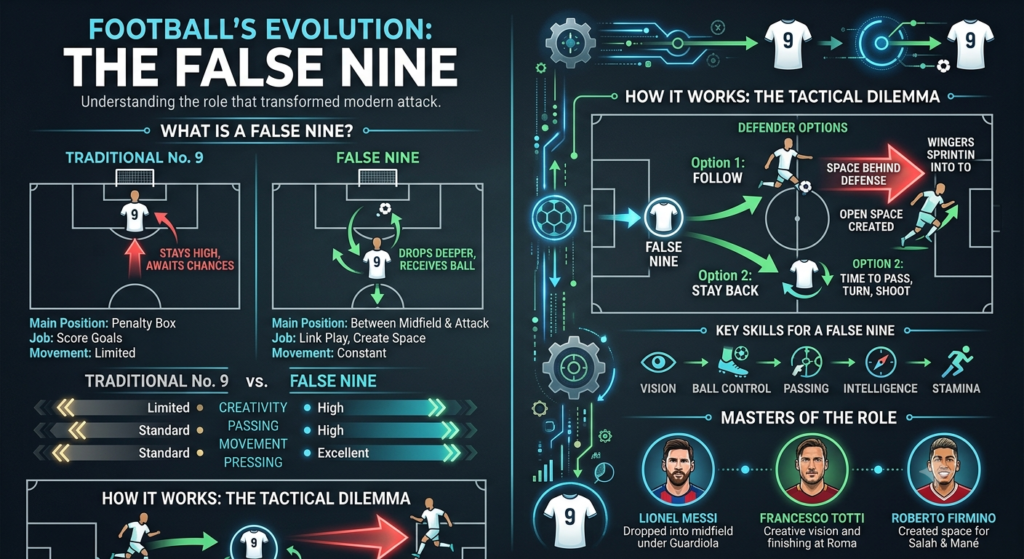
A false nine is a center forward who does not remain close to the opposition’s goal. Instead, the player frequently drops into midfield to receive the ball, link play, and create space for teammates making attacking runs.
Unlike a traditional striker who waits for scoring opportunities inside the penalty box, the false nine constantly changes position.
This movement forces defenders into difficult decisions:
- Follow the striker into midfield
- Stay in their defensive line
- Risk leaving space behind
Whichever option they choose often benefits the attacking team.
Traditional Number 9 vs False Nine
| Feature | Traditional Number 9 | False Nine |
|---|---|---|
| Main Position | Penalty area | Drops into midfield |
| Primary Job | Score goals | Create space and chances |
| Movement | Limited | Constant |
| Passing | Moderate | Excellent |
| Defensive Impact | Presses center-backs | Presses midfield and defense |
| Creativity | Lower | Very High |
The biggest difference is movement. A false nine is just as much a playmaker as a goalscorer.
Why Is It Called a “False Nine”?
The number 9 has traditionally belonged to the team’s main striker.
A false nine wears—or plays the role of—a number nine but doesn’t behave like one.
Instead of staying high up the pitch, the player operates between midfield and attack.
Because the player appears to be a striker while actually functioning like an attacking midfielder, the role became known as the false nine.
How Does a False Nine Work?
Imagine the striker suddenly leaving the penalty area.
The opposing center-back now faces two choices:
Option 1: Follow the striker
If the defender follows, space opens behind the defensive line.
Fast wingers or attacking midfielders can sprint into this gap.
Option 2: Stay in position
If the defender stays back, the false nine receives the ball freely between the lines and has time to turn, pass, or shoot.
Either scenario creates attacking opportunities.
Simple Movement Pattern
| Step | Action |
| 1 | False nine drops into midfield |
| 2 | Defender decides whether to follow |
| 3 | Space appears somewhere on the pitch |
| 4 | Wingers attack the open area |
| 5 | False nine creates or finishes the move |
Key Responsibilities of a False Nine
A successful false nine performs many different jobs during a match.
1. Linking Midfield and Attack
The player connects midfielders with the front line through quick passing combinations.
2. Creating Space
By dragging defenders away from their normal positions, teammates gain more room to attack.
3. Building Attacks
Instead of waiting for service, the false nine often starts attacking moves.
4. Pressing Defenders
Modern football requires forwards to defend from the front.
False nines are usually energetic players who press defenders aggressively.
5. Scoring Goals
Although creativity is important, a false nine must still finish chances when they arrive.
Skills Needed to Play as a False Nine
Not every striker can perform this role.
A false nine needs a unique combination of technical and tactical qualities.
| Skill | Importance |
| Ball Control | Excellent |
| Vision | Excellent |
| Passing | Excellent |
| Positioning | Excellent |
| Decision Making | Excellent |
| Finishing | Very Good |
| Dribbling | Very Good |
| Stamina | High |
These players think several passes ahead and understand where space will appear.
Famous False Nines in Football History
Several world-class players have made this role famous.
Lionel Messi
Perhaps the greatest false nine ever.
Under Pep Guardiola at Barcelona, Messi abandoned the traditional striker position and repeatedly dropped into midfield.
His movement confused defenders while opening space for teammates like Pedro and David Villa.
Francesco Totti
Before Messi popularized the role, Totti was already performing it brilliantly for Roma.
His creativity, vision, and finishing made him one of Italy’s greatest attacking players.
Roberto Firmino
Firmino rarely scored 30 goals a season, but his intelligence allowed Mohamed Salah and Sadio Mané to become devastating goal scorers.
Liverpool’s attack thrived because Firmino constantly created space.
Karim Benzema
Although capable of playing as a traditional striker, Benzema often drifted deeper to combine with midfielders and wingers.
His link-up play became one of Real Madrid’s biggest strengths.
Famous False Nine Players
| Player | Club Most Associated With Role |
| Lionel Messi | Barcelona |
| Francesco Totti | Roma |
| Roberto Firmino | Liverpool |
| Karim Benzema | Real Madrid |
| Cesc Fàbregas (occasionally) | Spain National Team |
Best Formations for a False Nine
The role works best when surrounded by quick, intelligent attackers.
4-3-3
This is the most common system.
The false nine drops deep while two wingers attack the empty spaces.
4-2-3-1
The attacking midfielder works closely with the false nine, creating overloads in central areas.
3-4-3
Wing-backs provide width while inside forwards attack centrally.
| Formation | Suitability |
| 4-3-3 | Excellent |
| 4-2-3-1 | Very Good |
| 3-4-3 | Very Good |
| 4-4-2 | Moderate |
Advantages of Using a False Nine
Modern coaches love this role for several reasons.
Better Ball Possession
Extra passing options help teams control matches.
More Creativity
Defenders struggle to predict movement.
Flexible Attacking Play
Players rotate positions naturally.
Creates Numerical Superiority
The false nine often gives the midfield an extra player.
Harder to Mark
Traditional center-backs prefer fixed targets.
Against a false nine, they constantly face uncertainty.
Disadvantages of a False Nine
The system isn’t perfect.
Lack of Penalty Box Presence
Sometimes no attacker is available to finish crosses.
Requires Intelligent Players
Poor positioning can make attacks ineffective.
Less Effective Against Deep Defenses
Teams sitting very deep leave little space behind their defense.
Tactical Comparison
| Tactical Aspect | Traditional Striker | False Nine |
| Holds Defensive Line | Yes | Rarely |
| Drops Into Midfield | No | Frequently |
| Creates Space | Limited | Excellent |
| Build-Up Play | Moderate | Excellent |
| Through Balls | Occasional | Frequent |
| Pressing | Standard | High |
Simple Match Example
Imagine Team A is using a false nine.
The striker receives the ball and immediately drops 15 yards into midfield.
One center-back follows.
At that exact moment:
- Left winger runs into the empty space.
- Right winger moves inside.
- Midfielder plays a through ball.
- The winger is now one-on-one with the goalkeeper.
The false nine may never touch the ball again during the move, but their movement made the goal possible.
This illustrates why coaches value the role so highly.
Goals vs Assists
A false nine isn’t judged only by goals.
Here’s an example of how contributions can be evaluated over a season.
| Statistic | Traditional Striker | False Nine |
| Goals | 28 | 18 |
| Assists | 5 | 15 |
| Chances Created | 32 | 74 |
| Key Passes | 40 | 93 |
Although the false nine scores fewer goals, the overall attacking contribution can be much greater.
Tactical Calculation
Suppose a false nine creates:
- 12 goals
- Scores 18 goals
Total direct goal contributions:
18 + 12 = 30 goal contributions
Now compare that with a traditional striker:
- Scores 24 goals
- Provides 4 assists
24 + 4 = 28 goal contributions
Even with fewer goals, the false nine contributes more to the team’s overall attacking output.
Which Teams Successfully Used a False Nine?
Several legendary teams have built their attacks around this role.
| Team | Coach | False Nine |
| Barcelona (2009–2012) | Pep Guardiola | Lionel Messi |
| Roma | Luciano Spalletti | Francesco Totti |
| Liverpool | Jürgen Klopp | Roberto Firmino |
| Spain National Team | Vicente del Bosque | Cesc Fàbregas (selected matches) |
Each team adapted the role slightly, but the underlying principle remained the same: movement, intelligence, and creating space.
Is the False Nine Still Popular?
Yes, although tactics continue to evolve.
Some teams now use hybrid forwards who combine the qualities of a traditional striker and a false nine. Others switch between systems during a match depending on the opponent.
Rather than disappearing, the role has become more flexible. Coaches often expect their center forwards to contribute to build-up play while still posing a goal threat.
Final Thoughts
The false nine is one of football’s most fascinating tactical innovations. Instead of relying solely on physical strength or penalty-box finishing, this role emphasizes intelligence, movement, and teamwork.
When played correctly, a false nine can transform an attack by pulling defenders out of position, creating passing lanes, and allowing teammates to exploit the space that appears. While the role demands exceptional technical ability and tactical awareness, its influence on the modern game is undeniable.
Whether you admire Lionel Messi’s brilliance at Barcelona, Francesco Totti’s elegance at Roma, or Roberto Firmino’s selfless play at Liverpool, each demonstrates why the false nine remains one of football’s most effective and entertaining positions. For fans, coaches, and aspiring players alike, understanding this role offers a deeper appreciation of how strategy can shape the beautiful game.
