


If you’ve ever watched a football match, you’ve probably focused on the players, the goals, and the excitement on the pitch. Yet one piece of equipment quietly plays an important role in every game the football net.
A properly installed goal net does more than catch the ball after a goal. It helps referees confirm when the ball has crossed the goal line, improves player safety, and gives every goal that satisfying ripple fans love to see.
Whether you’re setting up a football pitch at school, buying equipment for a local club, or simply curious about FIFA regulations, understanding football net dimensions is essential.
In this guide, we’ll cover the official football net size, goal dimensions, net depth, materials, and everything else you should know.
What Are Football Net Dimensions?
Football net dimensions refer to the measurements of the net attached to a football goal. These measurements include:
- Net width
- Net height
- Top depth
- Bottom depth
- Mesh size
- Twine thickness
The net must fit securely onto a regulation goal without interfering with play.
While the goalposts and crossbar have official dimensions under FIFA’s Laws of the Game, the net itself also follows recommended measurements to ensure consistency across competitions.
Official Football Goal Dimensions
Before understanding the net, it’s helpful to know the size of the goal it covers.
| Measurement | Metric | Imperial |
|---|---|---|
| Goal Width | 7.32 meters | 24 feet |
| Goal Height | 2.44 meters | 8 feet |
| Distance Between Posts | 7.32 m | 24 ft |
| Crossbar Height | 2.44 m | 8 ft |
Since the net is attached to the goal frame, these measurements determine the minimum size of the net.
Standard Football Net Dimensions
A regulation football goal net generally uses the following dimensions.
| Net Measurement | Standard Size |
|---|---|
| Width | 7.32 m (24 ft) |
| Height | 2.44 m (8 ft) |
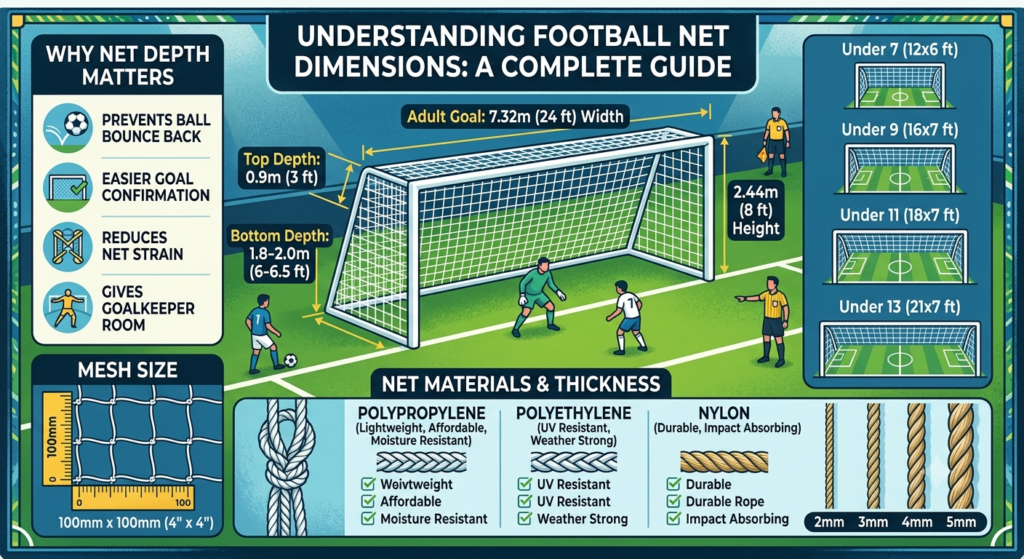
| Top Depth | 0.9 m (3 ft) |
| Bottom Depth | 1.8–2.0 m (6–6.5 ft) |
These dimensions allow enough space for the ball to settle naturally after entering the goal while preventing the net from interfering with players.
Why Is Net Depth Important?
Many people think only the goal width and height matter, but the depth of the net is equally important.
A deeper net offers several advantages:
- Prevents the ball from bouncing back onto the field.
- Makes goals easier for referees to identify.
- Reduces strain on the net after powerful shots.
- Gives goalkeepers enough room to retrieve the ball.
Professional stadiums often use deeper nets than local recreational pitches because matches involve faster shots.
Football Net Dimensions by Age Group
Not every football match uses a full-size goal. Youth football has different goal sizes, and the net dimensions change accordingly.
| Age Group | Goal Size | Recommended Net Size |
|---|---|---|
| Under 7 | 12 × 6 ft | 12 × 6 ft net |
| Under 9 | 16 × 7 ft | 16 × 7 ft net |
| Under 11 | 18 × 7 ft | 18 × 7 ft net |
| Under 13 | 21 × 7 ft | 21 × 7 ft net |
| Adults | 24 × 8 ft | 24 × 8 ft net |
Using the correct net size ensures fair play and proper training for players at every age.
Mesh Size of a Football Net
The mesh refers to the square openings formed by the netting.
Most regulation football nets have mesh openings measuring:
- 100 mm × 100 mm (4 × 4 inches)
- 120 mm × 120 mm for some recreational nets
The mesh should be small enough that a football cannot pass through but large enough to reduce wind resistance.
What Material Are Football Nets Made From?
Modern football nets are designed to withstand thousands of powerful shots throughout a season.
The most common materials include:
Polypropylene
- Lightweight
- Affordable
- Resistant to moisture
- Popular for schools and community pitches
Polyethylene
- UV resistant
- Strong against harsh weather
- Excellent for outdoor use
Nylon
- Premium option
- Extremely durable
- Used in many professional stadiums
- Absorbs impact effectively
Each material has its own advantages depending on budget and playing conditions.
Net Thickness Explained
Football net thickness is measured by the diameter of the twine.
| Twine Thickness | Typical Use |
|---|---|
| 2 mm | Backyard goals |
| 3 mm | Schools and training |
| 4 mm | Club football |
| 5 mm | Professional matches |
Thicker nets generally last longer and can absorb repeated high-speed shots more effectively.
How Much Area Does a Football Net Cover?
A standard goal opening measures:
Width × Height
= 7.32 × 2.44
= 17.86 square meters
This means the front face of a regulation football goal covers nearly 18 square meters.
When the net depth is included, the total amount of netting required is considerably larger, which is why professional goal nets use many meters of woven material.
Do FIFA Rules Require Goal Nets?
Interestingly, football can technically be played without nets.
However, FIFA strongly recommends their use in organized competitions because they:
- Clearly indicate when a goal has been scored.
- Improve match organization.
- Reduce disputes.
- Increase player and spectator safety.
Today, virtually every professional league and international tournament uses goal netsFIFA Regulations for Football Nets
Although most football fans pay attention to the size of the goalposts, FIFA also sets clear requirements for goal nets. According to the Laws of the Game, the use of nets is recommended for all official matches, provided they are properly secured and do not interfere with the goalkeeper or players.
A football net should:
- Be attached firmly to the goalposts and crossbar.
- Extend behind the goal without obstructing the goalkeeper.
- Be free from holes or damage.
- Prevent the ball from passing through or bouncing back onto the field.
Professional competitions often use support frames or net stanchions that hold the net away from the goalkeeper while maintaining its shape throughout the match.
How Are Football Nets Attached?
A football net may look simple, but installing it correctly is important for both safety and performance.
The installation process usually involves:
- Spreading the net evenly across the goal frame.
- Attaching the top edge to the crossbar.
- Securing both sides to the goalposts using clips, hooks, or cable ties.
- Fixing the rear of the net to ground pegs or support bars.
- Tightening the net so it hangs naturally without excessive tension.
If the net is too loose, the ball may become tangled. If it is too tight, powerful shots can rebound back into play, creating confusion for players and referees.
Professional vs Training Football Nets
Not all football nets are made for the same purpose. Professional stadiums require stronger and more durable nets than those used in schools or backyards.
| Feature | Training Net | Professional Net |
|---|---|---|
| Twine Thickness | 2–3 mm | 4–5 mm |
| Material | Polypropylene | Nylon or Polyethylene |
| Lifespan | Moderate | Long |
| Weather Resistance | Good | Excellent |
| Cost | Lower | Higher |
Training nets are lightweight and easy to install, while professional nets are designed to handle thousands of powerful shots throughout a season.
Indoor vs Outdoor Football Net Dimensions
Indoor football (also known as futsal) uses smaller goals than outdoor football. As a result, the nets are also much smaller.
| Feature | Outdoor Football | Indoor Football (Futsal) |
|---|---|---|
| Goal Width | 7.32 m | 3 m |
| Goal Height | 2.44 m | 2 m |
| Typical Bottom Depth | 1.8–2 m | 1–1.2 m |
If you’re buying a replacement net, always measure the goal first rather than assuming all football nets are the same size.
How to Choose the Right Football Net
Selecting the right football net depends on where and how it will be used.
For Home Use
Choose:
- Lightweight polypropylene
- 2–3 mm twine
- UV-resistant material
- Easy installation
For Schools
Look for:
- Medium-thickness twine
- Weatherproof construction
- Reinforced corners
- Easy replacement clips
For Football Clubs
A quality club net should include:
- Heavy-duty nylon
- 4–5 mm braided twine
- Strong knot construction
- Reinforced edges
- High weather resistance
Common Mistakes When Buying Football Nets
Many people purchase the wrong net simply because they overlook a few important details.
Avoid these common mistakes:
Buying the Wrong Size
Always measure:
- Goal width
- Goal height
- Net depth
A full-size net won’t fit a junior goal correctly.
Ignoring Net Depth
Some buyers only check the front dimensions.
A shallow net may:
- Catch the goalkeeper’s feet
- Cause the ball to rebound
- Wear out faster
Choosing Cheap Materials
Low-quality nets may save money initially but often require frequent replacement.
Investing in durable materials usually reduces long-term costs.
Forgetting Weather Conditions
If your goal remains outdoors all year, choose UV-resistant and waterproof materials.
Constant exposure to sunlight and rain can quickly weaken low-quality nets.
How to Maintain a Football Net
A well-maintained football net can last several years.
Simple maintenance includes:
- Inspecting for tears after matches.
- Cleaning mud and grass regularly.
- Tightening loose attachment points.
- Replacing broken clips immediately.
- Storing portable nets indoors during winter when possible.
These small steps help extend the net’s lifespan and improve safety.
Interesting Facts About Football Nets
Here are a few facts many football fans don’t know:
- Football nets were first introduced in the late 19th century.
- Before nets became common, referees often faced disputes about whether the ball had crossed the goal line.
- Modern professional nets are designed to absorb shots traveling at over 100 km/h.
- Different net colors, including white, black, blue, and green, are used in various leagues, though white remains the most common.
- Some stadiums use specially tensioned nets to create the dramatic ripple seen during televised matches.
Conclusion
Football nets may seem like a small part of the game, but they play a vital role in every match. A correctly sized and securely installed net helps referees confirm goals, improves player safety, and ensures a professional playing experience. For a regulation adult goal, the standard dimensions are 7.32 meters wide, 2.44 meters high, with a top depth of around 0.9 meters and a bottom depth of 1.8–2 meters. Whether you’re buying a net for a backyard setup, a school field, or a competitive club, choosing the right size and material will provide better durability and performance for years to come.
