


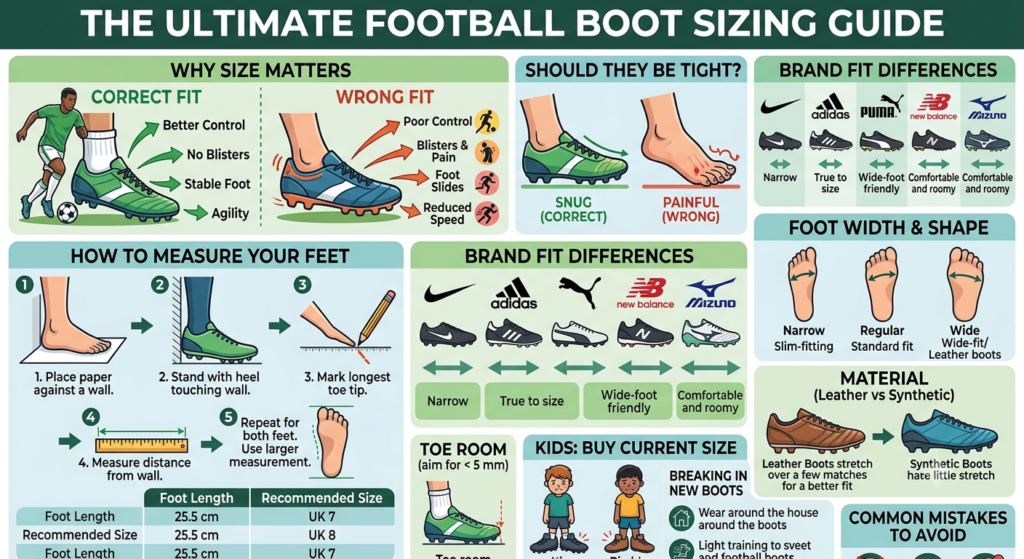
Buying a new pair of football boots is exciting, but choosing the wrong size can quickly ruin the experience. Boots that are too tight can cause painful blisters and pressure points, while oversized boots reduce ball control, slow down your movement, and increase the risk of injuries.
Whether you’re a beginner buying your first pair or an experienced player upgrading your boots, understanding football boot sizing is essential. Different brands use different sizing systems, and even boots from the same manufacturer may fit differently depending on their design.
This football boot sizing guide explains everything you need to know, from measuring your feet correctly to comparing UK, US, and EU sizes. By the end, you’ll know exactly how to choose boots that fit comfortably and improve your performance on the pitch.
Why Football Boot Size Matters
Football boots are designed to fit more snugly than everyday trainers. A close fit improves touch, control, balance, and stability while running, passing, and shooting.
Wearing the correct size provides several benefits:
- Better ball control
- Improved comfort
- Less foot movement inside the boot
- Reduced risk of blisters
- Better acceleration and agility
- Greater confidence during matches
On the other hand, wearing the wrong size can lead to discomfort and poor performance.
| Correct Fit | Wrong Fit |
|---|---|
| Better touch on the ball | Poor ball control |
| Comfortable during matches | Blisters and pain |
| Stable foot position | Foot slides inside boot |
| Improved acceleration | Reduced speed |
| Better balance | Higher injury risk |
Should Football Boots Be Tight?
One of the biggest misconceptions is that football boots should feel extremely tight.
The truth is that football boots should fit snugly but not painfully.
Your toes should lightly touch the front of the boot without being curled or cramped. There should be minimal empty space around the heel or sides.
A good football boot should feel like an extension of your foot.
How to Measure Your Feet
Before buying football boots online, measure your feet properly.
You’ll need:
- A sheet of paper
- Pencil
- Ruler or measuring tape
- Socks you normally wear for football
Step 1
Place the paper against a wall.
Step 2
Stand naturally with your heel touching the wall.
Step 3
Mark the tip of your longest toe.
Step 4
Measure the distance from the wall to your mark.
Repeat the process for both feet because one foot is often slightly larger than the other.
Always use the larger measurement.
Foot Measurement Example
| Foot Length | Recommended Size (Approx.) |
|---|---|
| 24.5 cm | UK 6 |
| 25 cm | UK 6.5 |
| 25.5 cm | UK 7 |
| 26 cm | UK 8 |
| 27 cm | UK 9 |
| 28 cm | UK 10 |
| 29 cm | UK 11 |
These sizes are approximate because every brand fits slightly differently.
Football Boot Size Conversion Chart
If you’re shopping internationally, this chart can help.
| UK | US Men’s | EU | Foot Length (cm) |
|---|---|---|---|
| 6 | 7 | 40 | 24.5 |
| 6.5 | 7.5 | 40.5 | 25 |
| 7 | 8 | 41 | 25.5 |
| 8 | 9 | 42.5 | 26 |
| 9 | 10 | 44 | 27 |
| 10 | 11 | 45 | 28 |
| 11 | 12 | 46 | 29 |
Always check the manufacturer’s official size guide before ordering.
How Different Brands Fit
Not all football boots fit the same.
Some brands produce narrow boots, while others offer wider designs.
| Brand | Typical Fit |
|---|---|
| Nike | Slightly narrow |
| adidas | True to size |
| Puma | Slightly narrow |
| New Balance | Wide-foot friendly |
| Mizuno | Comfortable and roomy |
Trying on different brands is the best way to find the shape that suits your feet.
Football Boot Width
Length isn’t the only thing that matters.
Foot width plays an equally important role.
Narrow Feet
Choose boots that naturally have a tighter fit.
Regular Feet
Most football boots fit standard-width feet.
Wide Feet
Look for boots with softer leather or brands known for wider fits.
| Foot Type | Recommended Fit |
|---|---|
| Narrow | Slim-fitting boots |
| Regular | Standard fit |
| Wide | Wide-fit or leather boots |
Leather vs Synthetic Boots
The material affects sizing.
Leather Boots
Natural leather stretches slightly after several matches.
If leather boots feel snug at first, they’ll usually become more comfortable over time.
Synthetic Boots
Synthetic materials stretch very little.
Make sure synthetic boots fit properly from the beginning.
| Material | Stretch Level |
|---|---|
| Leather | Medium |
| Synthetic | Low |
Should Kids Buy Bigger Boots?
Many parents buy football boots one or two sizes larger so children can “grow into them.”
Unfortunately, this often causes more problems than it solves.
Oversized boots can lead to:
- Less ball control
- Heel slipping
- Blisters
- Reduced balance
- Increased injury risk
It’s better to buy boots that fit correctly now rather than planning too far ahead.
How Much Toe Room Should Football Boots Have?
A football boot should have very little extra space.
Generally:
- Toes should lightly touch the front.
- No more than 5 mm of extra room.
- Heel should stay firmly in place.
Too much empty space reduces control when dribbling and shooting.
Signs Your Boots Are Too Small
Watch for these warning signs:
- Numb toes
- Pain while walking
- Cramped toes
- Pressure around the sides
- Toenail discomfort
- Blisters after every session
If these problems continue after a few training sessions, your boots are probably too small.
Signs Your Boots Are Too Big
Oversized boots create different problems.
Common signs include:
- Heel slipping
- Foot sliding forward
- Poor touch
- Loose feeling while sprinting
- Difficulty changing direction
Even half a size too large can affect performance.
Should You Wear Thick Football Socks?
Football socks should complement your boot size.
If you normally play in thick socks, wear them when trying on boots.
Changing sock thickness later can alter the fit.
Measuring Both Feet
Many people don’t realize their feet aren’t identical.
Example:
| Foot | Length |
|---|---|
| Left | 26.1 cm |
| Right | 26.5 cm |
In this case, choose the size that fits the 26.5 cm foot.
The slightly smaller foot can always be adjusted with proper lacing.
Boot Size Calculation Example
Suppose your measured foot length is:
26.7 cm
Looking at a size chart:
| Size | Foot Length |
|---|---|
| UK 8 | 26.0 cm |
| UK 8.5 | 26.5 cm |
| UK 9 | 27.0 cm |
Since 26.7 cm falls between UK 8.5 and UK 9, trying both sizes is ideal. If you’re buying online and the model runs small, UK 9 is usually the safer option.
Tips for Buying Football Boots Online
Shopping online is convenient, but sizing mistakes are common.
Before placing an order:
- Measure your feet carefully.
- Compare your measurements with the brand’s size chart.
- Read customer reviews about sizing.
- Check whether the boots run small or large.
- Confirm the store’s return policy.
Taking these steps can save time and avoid the hassle of returns.
Breaking In New Football Boots
Even correctly sized boots may feel a little stiff at first.
To break them in:
- Wear them around the house for short periods.
- Use them in light training sessions before a full match.
- Avoid soaking them in water.
- Lace them properly to secure your foot.
- Increase wearing time gradually.
Most quality boots become more comfortable after a few sessions.
Common Football Boot Sizing Mistakes
| Mistake | Better Choice |
|---|---|
| Buying one size larger | Choose a snug fit |
| Ignoring foot width | Consider width as well as length |
| Measuring without socks | Measure while wearing football socks |
| Assuming every brand fits the same | Check each brand’s size guide |
| Buying only by shoe size | Measure your foot length in centimeters |
Final Thoughts
Choosing the right football boot size is just as important as selecting the right playing surface or boot style. A well-fitted pair of boots enhances comfort, confidence, and overall performance, while the wrong size can lead to blisters, poor control, and unnecessary injuries.
The best approach is simple: measure both feet, compare your measurements with the brand’s size chart, consider your foot width and boot material, and aim for a snug fit with minimal extra space. With the right size, you’ll enjoy better touch on the ball, quicker movement, and a more comfortable experience every time you step onto the pitch.
