


The FIFA World Cup is the biggest football tournament in the world, watched by billions of fans every four years. While the spotlight is usually on legendary players and unforgettable matches, another important part of the tournament often goes unnoticed—the official match ball.
Every World Cup has its own specially designed football. It isn’t an ordinary ball that you can buy from any sports store. Instead, it is carefully designed, tested, and manufactured to meet FIFA’s highest standards. The official match ball is expected to perform consistently in different weather conditions, on different pitches, and at the highest level of competition.
One question football fans frequently ask is, “Who made the FIFA World Cup football?” Another common question is, “Which country manufactures the FIFA World Cup football?”
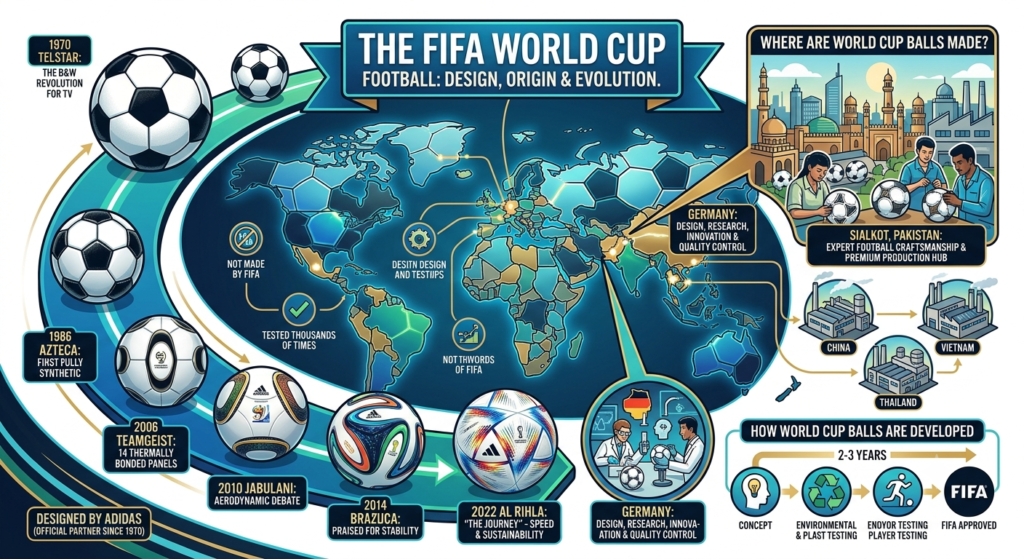
The answer is quite interesting because although Adidas designs every official FIFA World Cup ball, the footballs themselves are manufactured in different countries depending on the tournament and Adidas’ production facilities.
In this article, we’ll explore the history of the FIFA World Cup football, learn which country makes these famous balls, and discover how they have changed over the years.
Quick Answer
| Question | Answer |
|---|---|
| Who makes the FIFA World Cup football? | Adidas |
| Official FIFA partner since | 1970 |
| First Adidas World Cup ball | Telstar (1970) |
| Where are World Cup balls manufactured? | Pakistan, China, Vietnam, Thailand, and other Adidas manufacturing facilities depending on the model |
| Does FIFA manufacture the balls? | No, FIFA approves them while Adidas designs and manufactures them. |
Does FIFA Make the Official World Cup Football?
Many people believe FIFA manufactures the official football used in the World Cup. In reality, that isn’t the case.
FIFA is the governing body of international football. It organizes the tournament, sets the rules, and approves the official equipment. However, it does not own factories or produce footballs.
Instead, FIFA signs long-term agreements with sports equipment companies. Since 1970, Adidas has been responsible for designing and producing every official FIFA World Cup match ball.
Before each tournament, Adidas spends several years developing a completely new football. Engineers test hundreds of prototypes before FIFA gives its final approval.
Which Country Makes the FIFA World Cup Football?
One of the biggest misconceptions is that every World Cup football is made in Germany because Adidas is a German company.
The truth is different.
Adidas is headquartered in Germany, but most of its footballs are manufactured in countries where the company has specialized production facilities and experienced workers.
Over the years, official FIFA World Cup footballs have been produced in several countries.
| Country | Role in Manufacturing |
|---|---|
| Germany | Ball design, research, engineering, and quality control |
| Pakistan | Hand-stitched and premium football production (especially Sialkot) |
| China | Large-scale football manufacturing |
| Vietnam | Modern Adidas football production |
| Thailand | Selected Adidas football production |
Pakistan’s Important Role
One country deserves special attention—Pakistan.
The city of Sialkot is famous around the world for manufacturing high-quality footballs. For decades, skilled workers in Sialkot have produced footballs for leading international brands, including Adidas.
Several official World Cup training balls and premium football models have been manufactured in Pakistan. Even today, Sialkot remains one of the world’s largest football manufacturing hubs, exporting millions of footballs every year.
This is something many football fans don’t realize: a football used by some of the world’s best players may have been crafted by skilled workers in Pakistan before being shipped to Adidas for final branding and quality checks.
How Did Adidas Become FIFA’s Official Ball Manufacturer?
Before 1970, every FIFA World Cup looked a little different when it came to the football.
Different manufacturers supplied different balls, and there wasn’t one official match ball used throughout the tournament. This sometimes led to inconsistencies in quality and performance.
Everything changed during the 1970 FIFA World Cup in Mexico.
That year, FIFA partnered with Adidas to create one official match ball for the entire competition.
The result was the legendary Telstar.
Its black-and-white design became one of the most recognizable footballs ever made.
Interestingly, the famous black panels weren’t chosen just because they looked attractive.
During the 1970s, millions of people still watched football on black-and-white televisions. The contrasting pattern made the ball much easier to follow on screen.
That simple idea transformed football broadcasting forever.
Timeline of FIFA World Cup Ball Manufacturing
The official match ball has continued to evolve with every tournament.
| FIFA World Cup | Official Ball | Designed By | Main Manufacturing Locations |
|---|---|---|---|
| 1970 | Telstar | Adidas | Europe |
| 1974 | Telstar Durlast | Adidas | Europe |
| 1978 | Tango | Adidas | Europe |
| 1982 | Tango España | Adidas | Europe |
| 1986 | Azteca | Adidas | Europe |
| 1990 | Etrusco Unico | Adidas | Europe |
| 1994 | Questra | Adidas | Asia & Europe |
| 1998 | Tricolore | Adidas | Asia |
| 2002 | Fevernova | Adidas | Asia |
| 2006 | Teamgeist | Adidas | China |
| 2010 | Jabulani | Adidas | China |
| 2014 | Brazuca | Adidas | Pakistan & China (production varied by model) |
| 2018 | Telstar 18 | Adidas | Pakistan and China |
| 2022 | Al Rihla | Adidas | Pakistan, China, and other Adidas manufacturing partners |
Note: Adidas does not always use a single factory or country for production. Manufacturing locations can vary depending on the specific model, production batch, and tournament cycle.
Why Doesn’t Adidas Make Every Football in Germany?
People often wonder why a German company manufactures footballs in Asia instead of Germany.
The answer is simple.
Adidas has built a global manufacturing network over many decades. Countries like Pakistan, China, and Vietnam have highly skilled workers, specialized equipment, and decades of experience in producing premium footballs.
For example:
- Germany focuses on design, research, and innovation.
- Pakistan is famous for expert football craftsmanship.
- China and Vietnam handle advanced large-scale production.
- Every football still goes through strict Adidas quality testing before it receives FIFA approval.
This combination allows Adidas to produce millions of high-quality footballs while maintaining consistent performance for professional playersHow Is the FIFA World Cup Football Designed?
Designing the official FIFA World Cup football is far more complicated than simply choosing a new color or pattern. Every World Cup ball is the result of years of planning, research, and testing.
The process usually begins around two to three years before the tournament. Adidas engineers work alongside material scientists, product designers, and professional football players to create a ball that performs consistently in every match.
Before a final version is approved, hundreds of prototype footballs are tested in different environments. Some are used in cold weather, while others are tested in hot and humid conditions. Engineers also examine how the ball behaves on natural grass, artificial turf, and even during heavy rain.
The goal is simple: every player should experience the same level of control, accuracy, and consistency regardless of where the match is played.
The Journey from Design to the Football Pitch
Every official World Cup football goes through several stages before fans see it in the tournament.
| Stage | What Happens? |
|---|---|
| Research | Engineers study previous World Cup balls and identify areas for improvement. |
| Design | New graphics, panel shapes, and materials are created. |
| Prototype Testing | Hundreds of sample balls are produced and tested. |
| Player Feedback | Professional footballers test the ball during training sessions. |
| FIFA Approval | FIFA checks whether the ball meets official standards. |
| Mass Production | Approved footballs are manufactured in Adidas partner factories. |
| Tournament Use | The official match ball is used throughout the FIFA World Cup. |
This process ensures that every official match ball meets the highest international standards before it reaches the field.
How Has the FIFA World Cup Ball Changed Over Time?
The first World Cup footballs were made from genuine leather. While they were considered advanced at the time, they had one major weakness.
Leather absorbs water.
During rainy matches, older footballs became heavier, making them harder to control and more difficult to kick accurately. Goalkeepers especially disliked wet leather balls because they were slippery and unpredictable.
Modern footballs are very different.
Today’s World Cup balls are made from lightweight synthetic materials that resist water and maintain their shape throughout the match.
Comparison of Old and Modern World Cup Balls
| Feature | Older Footballs | Modern World Cup Balls |
|---|---|---|
| Material | Genuine Leather | Synthetic Polyurethane |
| Water Resistance | Low | Excellent |
| Weight | Increased when wet | Stays almost the same |
| Flight | Less predictable | More stable |
| Durability | Good | Excellent |
| Surface | Stitched panels | Thermally bonded panels |
These improvements help players deliver more accurate passes, powerful shots, and better first touches.
Famous FIFA World Cup Match Balls
Over the years, several World Cup footballs have become famous—not only for their design but also for the technology they introduced.
Telstar (1970)
The Telstar was the first official Adidas World Cup ball. Its black-and-white appearance became an icon of football and is still recognized around the world today.
Key Features
- First official Adidas World Cup ball
- 32-panel design
- Leather construction
- Improved visibility on black-and-white television
Azteca (1986)
The Azteca marked a major turning point because it was the first World Cup football made entirely from synthetic materials.
This innovation solved many of the problems associated with leather footballs, especially in wet weather.
Why It Was Important
- No leather
- Better water resistance
- More consistent performance
- Lighter than previous models
Teamgeist (2006)
For the 2006 FIFA World Cup in Germany, Adidas introduced the Teamgeist.
Instead of using the traditional 32 stitched panels, Teamgeist featured only 14 thermally bonded panels.
This created a smoother and rounder football.
Players noticed improved accuracy, while goalkeepers found it more difficult to predict the ball’s movement.
Jabulani (2010)
Few World Cup footballs have created as much debate as the Jabulani, used during the 2010 FIFA World Cup in South Africa.
It featured an advanced aerodynamic design intended to increase speed and improve accuracy.
However, many players—including several goalkeepers—claimed that the ball moved unpredictably, especially during long-range shots and free kicks.
Player Opinions
| Positive Feedback | Negative Feedback |
|---|---|
| Faster movement | Difficult for goalkeepers |
| Powerful shots | Unpredictable flight |
| Better speed | Harder to judge in the air |
Despite the criticism, the Jabulani remains one of the most talked-about footballs in World Cup history.
Brazuca (2014)
After listening to feedback about the Jabulani, Adidas developed the Brazuca for the 2014 FIFA World Cup in Brazil.
Before its official release, the Brazuca was tested by hundreds of professional players around the world.
The result was a football praised for its balance, stability, and control.
Many football experts consider it one of the best World Cup balls ever made.
Telstar 18 (2018)
The Telstar 18 paid tribute to the original 1970 Telstar while introducing modern technology.
One of its biggest innovations was an NFC (Near Field Communication) chip embedded inside the football.
This chip allowed fans with compatible smartphones to interact with the ball and access exclusive Adidas content.
Although the NFC chip did not affect the ball’s performance during matches, it demonstrated how technology was becoming part of football equipment.
Al Rihla (2022)
The official match ball for the 2022 FIFA World Cup in Qatar was called Al Rihla, which means “The Journey” in Arabic.
Adidas described it as one of the fastest World Cup footballs ever produced.
Main Features
- Lightweight construction
- Improved flight stability
- Textured surface for better grip
- High-speed movement through the air
- Made using water-based inks and glues to support more sustainable production
How Long Does It Take to Develop a World Cup Football?
Many fans are surprised to learn that a new FIFA World Cup ball isn’t created in a few months.
In most cases, Adidas spends between two and three years researching, designing, testing, and refining each official match ball.
Professional players, coaches, and goalkeepers are invited to test prototypes under real playing conditions. Their feedback helps engineers improve the ball before FIFA grants final approval.
This careful development process is one reason why every new World Cup football introduces noticeable improvements in design, durability, and performance.
Interesting Facts About FIFA World Cup Footballs
The official FIFA World Cup football has changed dramatically over the years, but a few interesting facts make its history even more fascinating.
1. Adidas Has Produced Every Official World Cup Ball Since 1970
Although FIFA organizes the World Cup, Adidas has designed every official match ball since the 1970 tournament in Mexico. That partnership has now lasted for more than 50 years, making it one of the longest-running collaborations in sports.
2. Pakistan Is One of the World’s Biggest Football Manufacturers
Many football fans are surprised to learn that Sialkot, Pakistan, is one of the world’s leading football manufacturing cities.
Millions of footballs are produced there every year for international brands. Several premium Adidas footballs, including versions related to the FIFA World Cup, have been manufactured in Sialkot by highly skilled workers.
3. Every New World Cup Gets a Unique Ball
Unlike league competitions that may use the same ball for several seasons, FIFA introduces a brand-new official football for each World Cup.
Each ball reflects the culture, colors, or identity of the host nation.
For example:
| World Cup | Official Ball | Meaning Behind the Name |
|---|---|---|
| 1970 | Telstar | Named after a communications satellite |
| 1986 | Azteca | Inspired by Mexico’s Aztec civilization |
| 2010 | Jabulani | Means “Celebrate” in isiZulu |
| 2014 | Brazuca | Brazilian spirit and culture |
| 2018 | Telstar 18 | Tribute to the original Telstar |
| 2022 | Al Rihla | “The Journey” in Arabic |
4. Modern Footballs Are Tested Thousands of Times
Before a World Cup ball reaches the tournament, it goes through extensive testing.
Some of the tests include:
- Speed tests
- Bounce tests
- Water absorption tests
- Shape retention
- High-pressure impact tests
- Flight stability analysis
Only after passing these tests does FIFA approve the ball for official matches.
How Much Does an Official FIFA World Cup Football Cost?
The price depends on the version you buy.
| Ball Version | Average Price |
|---|---|
| Official Match Ball (Pro Version) | $160–$180 |
| League Version | $60–$100 |
| Training Version | $30–$60 |
| Mini Ball | $15–$25 |
The Pro Version is the same model used by professional players during FIFA World Cup matches.
Final Thoughts
The FIFA World Cup football is much more than a simple piece of sports equipment. Every official match ball tells a story of innovation, engineering, and craftsmanship.
While Adidas has designed every official FIFA World Cup ball since 1970, the manufacturing process is truly global. Germany provides the research and design expertise, while countries such as Pakistan, China, Vietnam, and Thailand contribute their manufacturing skills. Among them, Sialkot, Pakistan, holds a special place in football history as one of the world’s most respected football-producing cities.
From the classic Telstar to the modern Al Rihla, each World Cup ball reflects the technology and style of its era. Whether you’re a casual fan or a passionate football follower, understanding the history behind the official match ball gives you a deeper appreciation of the game.
