


If you’re new to football—or even if you’ve watched the sport for years.you’ve probably wondered, how many players are on a football team?
The answer depends on what you mean by “team.”
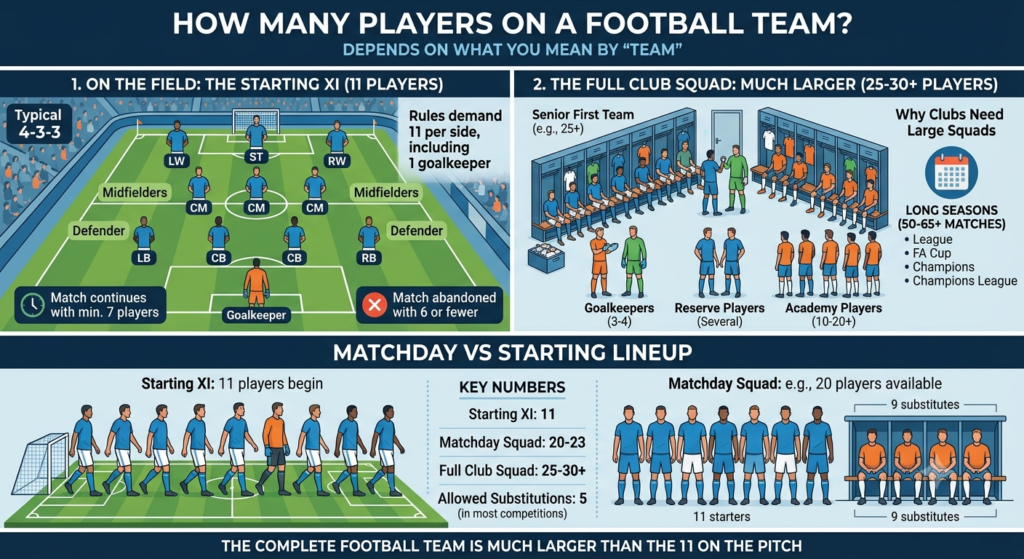
During an official football match, each side has 11 players on the field, including one goalkeeper. However, the full team usually consists of many more players because clubs need substitutes and reserve players throughout the season.
For example, a professional club competing in the Premier League may register a squad of up to 25 senior players, while youth players can often be added without counting toward that limit.
So although only 11 players begin the match, the complete football team is much larger.
The Simple Answer
Here’s the quick breakdown.
| Football Team Type | Number of Players |
|---|---|
| Players on the pitch | 11 |
| Goalkeepers | 1 |
| Outfield players | 10 |
| Matchday squad | Usually 20–23 |
| Full club squad | Around 25–30+ |
Most people asking this question are referring to the players on the field, and according to the Laws of the Game, each team starts with 11 players.
What Are the 11 Players?
Every football team is made up of different positions. Each player has a specific role that helps the team attack, defend, or control possession.
Here’s how a typical starting lineup looks.
| Position | Typical Number |
|---|---|
| Goalkeeper | 1 |
| Defenders | 4 |
| Midfielders | 3 |
| Forwards | 3 |
This setup is commonly known as a 4-3-3 formation, although teams often use different formations depending on their tactics.
For example:
- 4-4-2
- 3-5-2
- 4-2-3-1
- 5-3-2
Regardless of formation, every team still starts with 11 players.
Why Exactly 11 Players?
Football wasn’t always played with 11 players.
During the early days of the sport in England, different clubs followed different rules. Some teams used 12 players, while others played with 15 or even more.
Everything changed in 1863, when standardized rules began shaping modern football. Over time, 11 players per team became the accepted format because it provided the best balance between attack and defense on a full-sized pitch.
Today, FIFA and almost every football association around the world follow the same rule.
What Happens If a Team Has Fewer Than 11 Players?
Sometimes injuries, red cards, or unusual circumstances reduce the number of players available during a match.
A football match can continue as long as a team has at least seven players.
If the number drops below seven, the referee must stop the game because there aren’t enough players to continue safely and fairly.
Here’s a quick guide.
| Players Remaining | Match Status |
|---|---|
| 11 | Normal |
| 10 | Continue |
| 9 | Continue |
| 8 | Continue |
| 7 | Continue |
| 6 or fewer | Match abandoned |
This rule is one reason why red cards can dramatically change the outcome of a match.
Does the Goalkeeper Count?
Yes.
Many new fans ask whether the goalkeeper is included in the total number of players.
The answer is yes.
When we say a football team has 11 players, that total already includes the goalkeeper.
That means:
- 1 Goalkeeper
- 10 Outfield Players
Together, they make the official starting eleven.
What Is the Difference Between a Team and a Squad?
This is where many people get confused.
A team refers to the 11 players currently playing on the field.
A squad refers to every player available for selection, including substitutes and reserve players.
For example:
Manchester City may have over 30 professional players available during the season, but only 11 can start any individual match.
Think of it like this:
| Term | Meaning |
|---|---|
| Team | Players currently on the pitch |
| Squad | All registered players available during the season |
That’s why commentators often say:
“The manager has a strong squad.”
They’re talking about every player, not just the starting lineup.
Why Clubs Need Large Squads
Football seasons are long.
A top European club may play:
- League matches
- Domestic cup competitions
- European tournaments
- International club competitions
- Pre-season friendlies
Altogether, that can add up to 50–65 matches in a single season.
No group of 11 players could realistically play every minute without fatigue, injuries, or suspension.
That’s why clubs invest heavily in larger squads, giving managers the flexibility to rotate players and maintain performance across multiple competitions.
How Many Substitutes Are Allowed in Football?
For many years, football teams were allowed to make only three substitutions during a match. However, the rules changed after the COVID-19 pandemic to help reduce player fatigue.
Today, in most major competitions—including the Premier League, UEFA competitions, and FIFA tournaments—a team can make up to five substitutions during normal time.
These substitutions must usually be completed within three substitution opportunities (excluding halftime).
Current Substitution Rules
| Competition | Starting Players | Maximum Substitutes | Matchday Squad |
|---|---|---|---|
| Premier League | 11 | 5 | 20 |
| FIFA World Cup | 11 | 5 | 26 |
| UEFA Champions League | 11 | 5 | 23 |
| Most Domestic Leagues | 11 | 5 | 18–23 |
Although only 11 players start the match, managers can change tactics by introducing fresh players during the game.
Matchday Squad vs Starting Lineup
A football club doesn’t bring every registered player to a stadium.
Instead, the manager selects a matchday squad.
A typical matchday squad includes:
- 11 starting players
- 9 substitutes
That gives a total of 20 players available on matchday in many leagues.
Example
Suppose Liverpool has:
- 1 goalkeeper
- 4 defenders
- 3 midfielders
- 3 forwards
That equals 11 starters.
The bench might include:
- 1 goalkeeper
- 2 defenders
- 3 midfielders
- 3 attackers
Now the matchday squad becomes:
11 + 9 = 20 players
Example Calculation
Let’s imagine Team A starts a league match.
Starting XI
| Position | Players |
|---|---|
| Goalkeeper | 1 |
| Defenders | 4 |
| Midfielders | 3 |
| Forwards | 3 |
| Total | 11 |
During the match:
- 5 players are substituted.
- 5 new players enter the pitch.
Calculation
Starting players = 11
Players substituted off = 5
Players substituted on = 5
Players who appeared in the match:
11 + 5 = 16 different players
Even though only 11 players are on the field at any one time, 16 players may have taken part in the match.
How Many Players Are in a Professional Football Squad?
A professional club usually has more than just the players who appear on matchday.
Here’s a typical breakdown.
| Squad Type | Approximate Players |
|---|---|
| Senior First Team | 25 |
| Goalkeepers | 3–4 |
| Academy Players | 10–20+ |
| Reserve Players | Several |
For example:
A club could have:
- 25 senior players
- 8 academy players regularly training with the first team
That means the manager effectively has access to around 33 players during the season.
Why Do Clubs Need So Many Players?
Football is physically demanding.
A club competing in multiple tournaments might play 60 matches in one season.
Let’s look at an example.
| Competition | Matches |
|---|---|
| Premier League | 38 |
| FA Cup | 6 |
| League Cup | 6 |
| UEFA Champions League | 13 |
| Community Shield | 1 |
| Total | 64 Matches |
If every match lasts 90 minutes, the playing time is:
64 × 90 = 5,760 minutes
Now consider one player.
If they played every minute:
5,760 minutes ÷ 60 = 96 hours of competitive football
That doesn’t include:
- Training
- Extra time
- International matches
- Travel
- Recovery sessions
This is why managers rotate players throughout the season.
Can a Match Start With Fewer Than 11 Players?
Generally, no.
A team is expected to start with 11 players.
However, in rare situations—such as injuries during warm-ups or exceptional competition rules—a match may proceed if the minimum requirements are met under the competition’s regulations.
At professional level, clubs almost always begin with a full starting eleven.
Final Thoughts
Football may seem like a simple game, but understanding how teams are organized helps you appreciate the sport even more.
While every official match begins with 11 players on each side, that’s only one part of the picture. Behind every starting lineup is a larger squad made up of substitutes, reserve players, and academy talent who are all ready to step in when needed.
Modern football places huge physical demands on players, with clubs often competing across multiple tournaments in a single season. That’s why managers rely on squad depth, tactical substitutions, and player rotation to stay competitive from the first match to the last.
So, the next time someone asks, “How many players are on a football team?”, you’ll know the complete answer:
- 11 players take the field.
- Around 20 players are available on matchday.
- A professional club usually has 25–30 or more players in its senior squad.
Understanding these numbers makes following football easier, whether you’re watching the Premier League, the Champions League, the FIFA World Cup, or your local club.
