


When football fans look at a team before a new season, one of the first things they often want to know is who is on the squad. Which players are available? Who are the starters? Which youngsters have been promoted? Are there enough defenders and midfielders? Who can come off the bench when a match changes direction?
All of these questions are connected to the football roster.
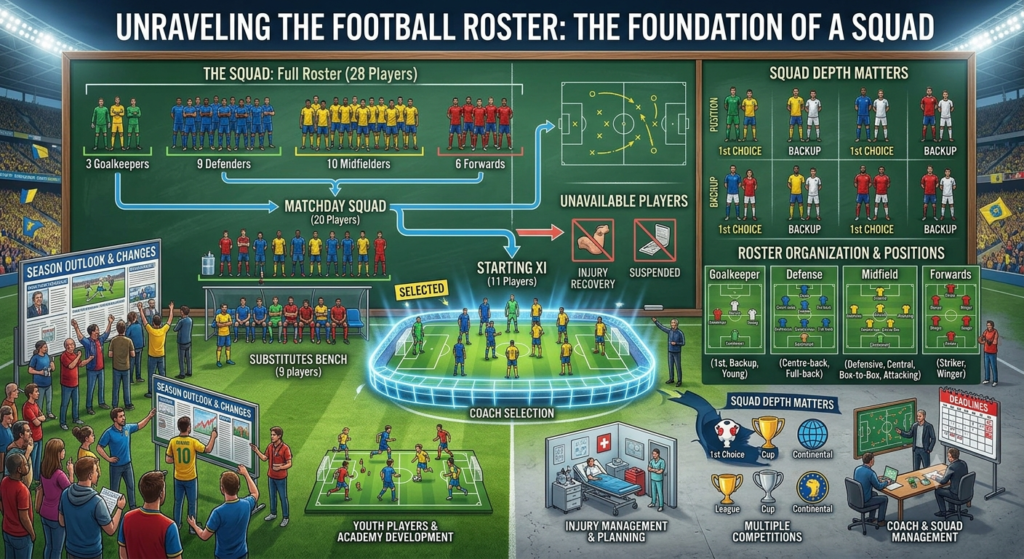
A football roster is essentially the list of players associated with a team for a particular season, competition, or match. Depending on the level of football, the size and rules surrounding a roster can be very different. A professional club may have a large group of players under contract, while a youth team or amateur side may operate with a much smaller squad.
Understanding a roster makes it easier to understand how a football team is built. It also explains why a coach cannot simply choose the same eleven players for every game.
What Is a Football Roster?
A football roster is a collection or list of players available to represent a team.
The word “roster” is especially common in American sports, but it is also used in football and soccer contexts to describe a team’s group of players.
A typical roster can include:
- Goalkeepers
- Defenders
- Midfielders
- Forwards
- Young or reserve players
- Substitute options
- Players recovering from injuries
- Players registered for a specific competition
Not every player on a roster will play in every match.
A coach selects a starting lineup from the available players and then chooses substitutes according to the competition’s rules.
This means a roster is much larger than the eleven players who start a particular match.
Football Roster vs Starting XI
One of the easiest ways to understand the difference is to compare a roster with a starting lineup.
The roster represents the wider group of players.
The starting XI represents the eleven players selected to begin a specific match.
For example, a club might have 25 or more senior players available during a season. The coach may choose only eleven to start a weekend league match.
The remaining players can be substitutes, unavailable players, injured players, or members of the wider squad.
| Term | Meaning |
|---|---|
| Roster | Full group of players available to a team |
| Starting XI | Eleven players who begin a match |
| Substitute | Player selected on the bench who may enter the game |
| Squad | Often used to describe the team’s group of players |
| Reserve | Player outside the regular starting group who remains available |
| Academy player | Young player developing within the club |
How Is a Football Roster Organized?
A balanced football roster normally contains players for every major position.
A basic structure might look like this:
| Position | Typical Role |
|---|---|
| Goalkeeper | Protects the goal and organizes the defense |
| Centre-back | Defends centrally and deals with aerial threats |
| Full-back | Defends wide areas and supports attacks |
| Defensive midfielder | Protects the defense and helps build play |
| Central midfielder | Connects defense and attack |
| Attacking midfielder | Creates chances and supports forwards |
| Winger | Attacks from wide positions |
| Striker | Main attacking and goal-scoring threat |
The exact number of players in each position depends on the team’s tactical system.
A team that frequently uses three centre-backs may require more central defenders than a side that normally plays with four at the back.
Likewise, a coach who prefers attacking wingers may want several wide players available.
Why Squad Depth Matters
One of the biggest reasons football rosters are important is squad depth.
Football seasons can become extremely demanding. A club may have domestic league matches, cup competitions and continental games packed into the same period.
Players can become tired or injured.
If a team has only one reliable player for each position, problems can develop quickly.
Imagine a club with one experienced goalkeeper, four defenders, six midfielders and three forwards. If several players are injured at the same time, the coach may have to change the team’s normal formation or use inexperienced youngsters.
A deep roster gives the coach more options.
Goalkeepers on a Football Roster
Goalkeepers occupy a unique position.
Only one goalkeeper normally starts a match, but teams usually need additional goalkeeping options in case of injury, suspension or other circumstances.
A professional roster may contain:
- First-choice goalkeeper
- Backup goalkeeper
- Young goalkeeper
The backup is particularly important because goalkeepers can rarely be substituted into an outfield role.
Goalkeeping also requires specialist training, which is why clubs normally have dedicated goalkeeper coaches.
Defenders on the Roster
Defenders form the foundation of a team’s defensive structure.
A roster may include centre-backs, full-backs and wing-backs.
Centre-backs generally operate in central defensive areas, while full-backs are expected to defend wide positions. Wing-backs often have more attacking responsibilities.
A coach must consider different characteristics when building this part of the roster.
One defender might be strong in the air. Another might be quick enough to cover space behind a high defensive line. A full-back may offer excellent crossing ability.
Having different types of defenders gives the coach tactical flexibility.
Midfielders and Roster Balance
Midfield is often the most complicated area of a roster.
Midfielders can perform very different jobs.
A defensive midfielder may sit in front of the defense, while a box-to-box midfielder covers large areas of the pitch. An attacking midfielder may concentrate more heavily on creating chances.
Because midfielders have different responsibilities, coaches often want several profiles rather than a collection of identical players.
For example, a team may need:
- A ball-winning midfielder
- A deep playmaker
- A box-to-box midfielder
- An attacking midfielder
- A technically gifted substitute
This variety can help a coach change the team’s approach during a match.
Forwards and Attacking Options
Goals are often the most difficult thing to replace.
A football roster therefore needs enough attacking options to handle injuries, suspensions and changes in form.
A club might have:
- Centre-forward
- Second striker
- Left winger
- Right winger
- Versatile forward
Modern forwards are often expected to play multiple positions.
A striker who can also operate on the wing gives the coach another option when changing formations.
The Role of Substitutes
The roster becomes especially important when a match enters its final stages.
Substitutes can change the rhythm of a game.
A coach may introduce a fast winger against tired defenders or bring on a defensive midfielder to protect a narrow lead.
Some substitutes are selected because they can immediately influence the match. Others may be included because they provide cover for specific positions.
The bench is therefore not simply a collection of unused players. It is part of the tactical plan.
Football Roster Rules
Roster rules depend heavily on the competition.
Professional leagues and tournaments can have their own registration requirements, squad limits and rules concerning young or locally developed players.
For example, a competition may require clubs to register a certain number of players who meet particular development criteria.
There can also be separate rules for:
- Domestic competitions
- Continental competitions
- Youth competitions
- International tournaments
- Cup competitions
Because regulations can change, clubs have to pay close attention to registration deadlines and eligibility rules.
Matchday Roster
A season roster and a matchday squad are not necessarily the same thing.
A club may have many registered players, but only a limited number can normally be selected for an individual match.
The coach chooses the matchday group according to factors such as:
- Opponent
- Injuries
- Suspensions
- Fitness
- Tactical plan
- Player form
- Competition rules
- Recent workload
This explains why a famous player might be part of the overall roster but not appear in a particular match.
Injuries and the Football Roster
Injuries can completely change a team’s plans.
A club may begin a season with what appears to be a perfectly balanced roster. After several injuries, however, the same squad can suddenly look much weaker.
For this reason, coaches and sporting directors often consider depth when building a roster.
They may ask:
What happens if our starting left-back is injured?
Who replaces our main striker?
Can this midfielder play as a defender if necessary?
Do we have enough experienced players for a busy month?
These questions are part of squad planning.
Youth Players and Academy Graduates
A football roster does not always have to be built entirely through transfers.
Many clubs develop young players through their academies.
An academy graduate may initially train with the senior team while continuing to play youth football. If the player develops well, the coach may eventually give them a place in the senior squad.
Young players can provide several benefits:
- Long-term development
- Squad depth
- Lower recruitment costs
- Competition for established players
- Club identity
Some of football’s greatest players began their careers in youth academies before becoming important members of senior teams.
Building a Balanced Football Roster
Creating a strong roster is not simply about collecting the best individual players.
A club could sign ten talented attackers and still have a poorly constructed squad.
Balance matters.
A roster needs enough defensive players, midfield options, goalkeepers and attacking players. It also needs players with complementary qualities.
For example, two central midfielders might both be excellent passers but struggle defensively. Another pair may provide better balance because one specializes in defensive work while the other creates chances.
This is where recruitment and coaching work together.
Example of a Balanced Roster
Here is a simplified example of how a professional football roster could be structured:
| Position | Example Number |
|---|---|
| Goalkeepers | 3 |
| Centre-backs | 4 |
| Full-backs/Wing-backs | 4 |
| Defensive/Central Midfielders | 5 |
| Attacking Midfielders | 3 |
| Wingers | 4 |
| Strikers | 3 |
| Total | 26 |
This is only an example. There is no universal roster size that works for every team.
A club using a three-defender system might need a different balance from a team that relies on a traditional back four.
Football Roster Management
Managing a roster can be almost as difficult as managing a match.
Coaches need to keep players motivated even when they are not starting regularly.
If a player spends months on the bench, frustration can grow. A good coach needs to communicate with that player and explain what they need to improve.
Competition for places can also be healthy.
When players know that another teammate is capable of taking their position, training intensity can increase.
However, too much competition without proper communication can damage team morale.
The best roster management combines competition with trust.
Roster Changes During a Season
Football rosters are not always fixed for the entire year.
Depending on league and competition rules, clubs may change their squads during transfer windows.
Players can:
- Join the club
- Leave permanently
- Go on loan
- Return from loan
- Move between youth and senior teams
- Become unavailable because of injury
These changes can significantly alter a team’s tactical options.
A club struggling with injuries might use the transfer market to add another player. Another team may sell an established star and promote a young academy player.
Why Fans Follow Football Rosters
For supporters, a roster is more than a list of names.
It provides a picture of what the upcoming season might look like.
Fans want to know whether their team has strengthened its defense, added creativity in midfield, or found a replacement for a departed striker.
Roster announcements can therefore create considerable excitement before a new season.
They also help supporters understand the decisions a coach makes.
If a team has three natural right-backs, for example, fans may wonder why the coach uses a midfielder in that position. Looking at the roster can provide some context.
Final Thoughts
A football roster is the foundation of a team’s squad structure. It contains the players a club or team can rely on throughout a season and provides the depth needed to deal with injuries, suspensions, fatigue and tactical changes.
The strongest rosters are not necessarily those with the biggest names. They are usually the ones with the right balance of talent, experience, versatility and depth.
Goalkeepers need dependable backups. Defenders need suitable alternatives. Midfielders should offer different qualities, while forwards need enough variety to give the coach attacking options.
Youth players can add energy and long-term potential, while experienced players can provide leadership during difficult matches.
Ultimately, football is played by eleven players at a time, but successful teams depend on a much larger group. The roster gives coaches the choices they need before and during a long season.
That is why understanding a football roster can tell you much more about a team than simply looking at its starting lineup. Behind every matchday XI is a larger group of players, coaches and staff working together to give the team its best chance of success.
